The Necessity of Empty Places*: Prescribing Nature for What Ails Us
- Dr. Karen I. Shragg
- April 16, 2026
- Forum Papers
- Forum Paper
- 0 Comments
Click here for a downloadable, printable PDF version.
An NPG Forum Paper
by Karen I. Shragg, Ed.D
April 2026
ABSTRACT
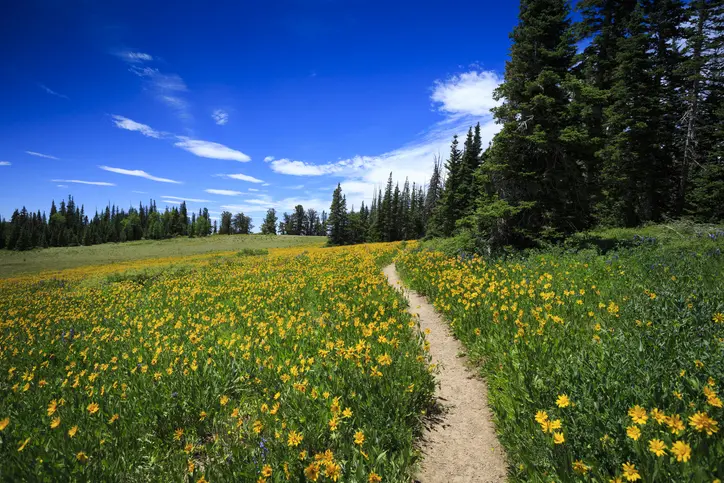
For those who can partake, the natural world offers a break from our often-chaotic lives. Remedies for stress brought on by personal or political upheaval and uncertainty increasingly point to a real-world remedy: get out into nature. It is indisputable that this advice is well supported by evidence, but what happens if access to nature disappears? Population growth is putting development pressure on our natural areas, decreasing opportunities to use nature as our salve just when the demand for its benefits are increasing.
*I would like to acknowledge the late Paul Gruchow — writer, conservationist, and keen observer of the American landscape — whose book The Necessity of Empty Places inspired the title of this paper for NPG. His work continues to resonate with those concerned about stewardship and restraint.
NATURE DEFICIT DISORDER
In 2005, author Richard Louv coined the phrase, “nature deficit disorder,” to describe the way the alienation from the natural world was behind so many disorders diagnosed in children. While not a medical condition per se, Louv makes a good case for how we have removed ourselves from the rhythms and lessons of the forest and prairies only to substitute them with the banality and noise of the unnatural indoor world.1
I grew up in a world where we were allowed to roam free in our neighborhoods and told not to come home until the dinner bell rang. During those glorious unsupervised hours, I was able to find my way through the neighboring woods to splash about in the stream, catch minnows and hang out in the sturdier tree branches.
It has been startling to witness the downward slide into stress that the more sheltered and smothered childhoods of today now offer. We didn’t need a nature prescription in the 60s, that wasow we lived. Today, understanding that the freedom to explore has been lost to “stranger danger” and the predilection for safety, the effort to recapture those days is deeply defensible and commendable.
Poet Paul Gruchow wrote about the way we need empty places to find ourselves or risk submitting to a world that is unnatural to the way we evolved. We are genetically similar to when we were hunter-gatherers. From an evolutionary perspective, we haven’t lived indoors for very long. We have not adapted well to the lack of activity, artificial light and lack of excitement offered by daily encounters with wild things in the outdoors. When outdoor recreation is treated with misgivings or is absent altogether, young people are deprived of a world that they need.
Modern humans have certainly made gains with the all-consuming technology and medical advances we so often take for granted. But these gains have come at great cost. As a species, we have been a force on this planet for 10,000 generations give or take a few. As a genus we have been around 10 times that long. Prior to the last 600 generations we were hunter-gatherers. We were mobile, outdoors and adept at sourcing food and medicine in the wild. As successful hunter-gatherers we got plenty of exercise and enjoyed foods rich in fiber, untainted protein, and nourishment without chemicals, simple sugars and the gut destroying overly processed snack food.
Today’s more sedentary children may live longer, but have traded longevity for higher obesity rates, more diabetes, cancers and heart disease. Our scientists are always on the verge of creating new medicines, but they are likely not as powerful as the millions of years of natural selection we hold within our genome which means it would be better for us to live more like our hunter-gatherer ancestors did.2
Nature is a balm that cures us, if we know how to use it. Even Anne Frank wrote, “Nature brings solace in all troubles.”3
Ecotherapy is a newly coined word offering suggestions of mindful walks and meditations to deal with experiences of grief. Forest bathing is another activity to get people of all ages away from their computers and out into the wild.
We must address the sobering fact that we are losing the very nature we need for our mental as well as physical health. As a naturalist and nature center director for 35 years in an urban setting, I saw time and again the way my nature center, just blocks away from a gas station and the accoutrements of city life, was frightening to students who had no exposure to its wonders.
Many advise all of us to get out in nature and that is fine, but as our population grows this becomes more and more difficult to access in some areas. It even becomes a scary proposition without leadership. Take a walk in the park. Go out and see the stars. Both sound great but are less and less achievable. Even our national parks are becoming so crowded that experiencing their beauty must be done at the end of a long line of buses, cars and trucks – and sometimes only if you made a reservation weeks or months in advance.
In follow up books, Louv has offered ways for individuals, families and communities to connect with nature which is all well and good, but what if our untethered population growth has diminished those opportunities for connection?
Every year we lose acres and acres of land to prawl. Just a few generations ago there were empty lots to explore and streams in which to seek out adventures within proximity to our large populations. They are now being bulldozed into cul-de-sacs and shopping malls. “Go outside and play” used to mean that there were frogs to catch and bugs to observe. Those are dying off as well.
If being outside in nature is the remedy for our mental illness, we had better treat it as a precious resource instead of selling it off to the highest bidder. In 2015, a follow up book, “Vitamin N” offered 500 ways that individuals, families and communities could incorporate more nature connection into their daily lives. Transforming lives is now available only to those able to get far enough away from the crowded inner cities to experience the magic and beauty nature has to offer.
NATURE AS A REMEDY FOR WHAT AILS US
Ever since the wildly popular book, “The Last Child in the Woods, Saving Our Children from Nature Deficit Disorder” came out in 2005, the US has gained population, become more urbanized and lost open land as a result. 295 million in 2005 has grown to just over 342 million today. The additional 47 million people represent high population density on the land and decreased access to nature. The Conservation Fund recently shared that 40 acres of farmland are being lost every hour in the U.S. and that we are going to lose 13 million acres of forests in the coming decades. That poses many problems beyond access to nature, including the detrimental effects of climate change and potential water scarcity since fresh water supplies come mostly from our forested areas.4
Population pressure is the silent force behind the loss of our wild areas. The increase in numbers spawns a litany of development from housing, schools and strip malls to energy demanding data centers and power plants. The non-profit group, Conservation Science Partners, in collaboration with the Center for American Progress, found that these activities are causing, “the persistent and rapid loss of America’s natural areas.” Referred to as a human footprint, it was responsible for losing a football field worth of natural area every 30 seconds from 2001 to 2017. The South and Midwest are in the gravest danger of succumbing to these steep losses. We are on track to lose an area the size of South Dakota by 2050.5
According to the website 10minutewalk.org, currently “1 in 3 U.S. residents do not have a park or green space within a 10-minute walk from home. 100 million people (including 28 million children) do not have access to parks.”6
There is no dispute that alienation from nature is causing harm to young and old. But this alienation is less and less redeemable with a growing population.
Since the publication of Louv’s book (which discussed the impact on families and communities) there have been nearly a thousand studies on the topic. All suggest the same thing, that alienation from nature is attributable to everything from attention disorders to a range of emotional and physical illnesses including alarming rates of childhood obesity.
A study in 2015 by Stanford University compared the mental health of those living in rural areas versus those living in cities. They found that:
“…city dwellers have a 20 percent higher risk of anxiety disorders and a 40 percent higher risk of mood disorders as compared to people in rural areas. People born and raised in cities are twice as likely to develop schizophrenia.”7
In 2011 Louv published another book, The Nature Principle: Human Restoration and the End of Nature-Deficit Disorder, which delves deeper into the importance of a connection with the natural world. In it he puts forward the idea that consciously reconnecting with nature can be restorative in many ways. From mental acuity to improved immunity and creativity, he is betting on a world that will be run by nature-smart people who are more compassionate because they take their cues from living in and around the natural world.
Even prior to Louv’s work, the concept of Shinrin-Yoku came out of Japan to encourage getting out into the forest in what is now referred to as, “forest bathing.” A holistic preventative practice with roots in Shinto and Buddhist practice, forest bathing has now become a worldwide phenomenon.
LOSING ACCESS TO SILENCE AND SOLITUDE
Bird and frog calls, wolves howling, and elk bugling are noisy, but they are the sounds that awaken our spirits, not ones that deaden our souls. Our genetics haven’t changed much since the dominant sounds we heard were the hooting of owls and the rustling of leaves. While we may get used to city noises, they are not helping us to stay calm and centered as many in the nature therapy world recommend. We are destroying the opportunities for solitude so that we can hear our inner voices. Solitude is distinct from aloneness which is not a choice. Choosing to be in a space of solitude is to desire to be quiet enough to hear one’s own inner voice and stop the noise of societal pressures and expectations. As our population grows and sprawls both outward and upward, we are obliterating the silence we need.
Well-planned cities leave room for open spaces and parks. Green spaces are aesthetically pleasing, and they provide designated space for outdoor exercise. They are where we can bike, run and walk with our dogs. Open spaces aid in carbon absorption, while being just minutes away from restaurants and shopping malls. They allow for some special nature encounters. But one cannot escape to them for silence and solitude. Sirens, barking dogs, screaming children, construction noise will be there in the background interrupting a deep connection that can heal. I know this because I ran an urban nature center of 150 acres right next to a freeway and so close to our international airport you had to stop your outdoor class when the planes took off. I fought for a freeway wall to be built to protect our hikers and students from the disconcerting freeway noise and succeeded, but still the hum of the freeway interrupted efforts to get away from it all. That freeway hum got louder and louder throughout my tenure there. The reason is in the numbers. When I was hired in 1991, the Twin Cities Metro area was home to 2,538,834. Fast forward to the end of my employment as a nature center director and there was an extra lane added to the freeway to accommodate the cars that accompanied a growth of 1,151,327 people. The nature center offered environmental education and recreation experiences for children and families. We were the closest natural area to the inner city where it was unsafe to spend time outdoors. It felt good to offer some experiences that residents would otherwise not be able to enjoy. Still, they were not even close to benefitting from the solitude and silence of real wilderness where the footprint of civilization is absent.
We naively bought a large telescope one year with a technology grant but the scope never made it out of the package because we had to admit that being so close to the city made the night sky hard to see. Light pollution comes with growth and with it we lose our ability to feel our place in the universe.
There was an atlas made of the night sky in 2016. The World Atlas of Artificial Brightness found that 80 percent of the world’s population lives under the din of the artificial lights given off by civilization at night. In the U.S. and Europe, the statistics are even worse. The same atlas estimates that 99% of the public in these areas cannot experience a natural night.8
New York City is famous for being the city that never sleeps but this means that artificial light is on all night long and real stars are seldom seen. This is called “sky glow” and it blocks out the dimmer stars that were visible when we were hunter-gatherers.
ANOTHER REASON FOR CONSERVATION
Nature clearly has a heavy burden to lift. We know it needs to be protected for its role in easing climate change and for protecting watersheds, plants and animal habitats. Nature is not just a cure for what ails us, loving it holds the key to preserving it. Jacques Cousteau, the great ocean explorer, once said “people protect what they love.” To love the natural world, one must experience it first. As the U.S. becomes more urbanized the connection to nature is at risk. “By the year 2020, about 82.66 percent of U.S. population was considered to be urbanized, that is they lived in cities and greater urban areas.”9 Because the U.S. was an early entrant into industrialization, its urban population became larger than its rural population by the 1910s. It is projected that by the middle of this century nearly 90% of the population will be living in urban settings.
Many psychologists recommend sending people into nature for its mental and physical health benefits. Nature is facing increasing responsibilities at a time when it is shrinking. One of the key principles of forest bathing is to embrace nature’s bounty. This seems more theoretical than realistic. The problem of losing natural areas to the bulldozers brought on by population growth and urban sprawl must be addressed. Those who keep recommending that we go outdoors and seek the benefits of the wild are naïve. They need to call for policies that protect wildlands while simultaneously pointing out the need for engaging in its exploration.
CONSERVATION AND SCALING DOWN: A NEEDED PARTNERSHIP
There are some amazing projects underway to protect our remaining natural areas. One of them is Project 30 X 30. The scientific evidence for needing to protect at least 30% of land and oceans by 2030 is not being disputed here. What is being disputed is that it cannot be done without curbing population growth which will always threaten even our most protected areas because of the inherent economic pressures of supply and demand.
Authors Phil Cafaro, Pernilla Hanson and Frank Götmark said in their Biological Conservation article that, “During the past hundred years, Homo sapiens‘ population increased from 2 billion to nearly 8 billion and the United Nations (2019) projects an increase of 3 billion more by 2100, unless steps are taken to reduce this population growth. Ignoring this projected increase means ignoring a major driver of the unfolding biodiversity crisis; accepting current bloated human numbers as an appropriate status quo means accepting a biologically impoverished planet.” They also state in the article how the overpopulation issue used to be a topic that was discussed as a driver of habitat loss but now is rarely used in scientific literature.10
Overpopulation is not addressed in any of the popular get-back-to-nature literature either. Johns Hopkins Center for Health Equity is a huge proponent of green spaces, claiming that they play a role in the health of our cardiovascular system. Nowhere to be found in their prescription for getting outdoors is a call to protect and provide access to these ever-precious spaces.11
Even the government is getting in on this advice. The U.S. Forest Service, an agency of the U.S. Department of Agriculture, recommends getting into the woods as a way to soothe one’s traumas especially after disastrous wildfires.12 Once again, there is no mention of the need to conserve these spaces, just an underlying assumption that they will always be there for those who decide to take advantage of their healing powers.
A 2016 article in Time Magazine focused on high blood pressure – an ailment which affects 1 in 3 Americans and costs about 48.6 billion dollars per year in medical expenses and lost productivity – and how being in the forests can help to lower our blood pressure numbers. While the article does mention that most people live in cities and away from nature, it does not use this information to call on the need to create more city parks and keep close tabs on our growth.13
Paul Gruchow was an amazing poet and author who I had the privilege of hiring for a festival at my nature center years ago. He wrote the book, The Necessity of Empty Places, and promoted the idea that we are the ones losing out when we ignore the lessons of rural landscapes.14 He didn’t mean that they were empty of life, just empty of human infrastructure. They were actually full of life – plant, insect, bird and mammal life. He said, “We are putting ourselves on the endangered species list. We may have lost our awe of nature, but its power remains, and to the extent that we are unmindful of that power, we are less, not more, secure.” His writings helped create a conservation mindset among his followers.15
Poet and farmer Wendell Berry had a holistic approach to land conservation. He advocated for taking care of the land so it could then take care of us. In the act of careful stewardship, one learns how the land works and conserves it at the same time. His advocacy was to turn the clock back to a time when farmers lived on the land they farmed and owned it. It is hard to argue with his point that the loss of stewardship and the experience of living on the land is at the heart of what is now wrong with America. “We no longer have a farm vote, because we no longer have a contingency of farmers,” Berry said. “Between 1910 and 1920, we had 32 million farmers living on farms – about a third of our population. By 1950, this population had declined, but our farm population was still 23 million. By 1991, the number was only 4.6 million, less than 2 percent of the national population. That is, our farm population had declined by an average of almost half a million people a year for forty-one years. Also, by 199l, 32 percent of our farm managers and 86 percent of our farmworkers did not live on the land they farmed.”16 Not only did we lose family farms we gained approximately 161 million in population during those years.17
Corporate farming – with the help of farm subsidies from the farm bill – lends itself to bad stewardship and the use of pesticides. It also keeps land expensive and makes it very difficult for individual families trying to survive on a small farm. The advocacy to go back to the land or into the forest has great intentions and wonderful goals. The problem is that we have industrialized ourselves away from the land and population growth has made these advocacies mathematically daunting.
Urban sprawl studies have the same story to tell. In Sprawl USA’s Executive Summary, it was out to prove Project 30 X 30’s goal to save land was not possible without controlling population growth. To protect 30% of our landscape by 2030, population growth must be stopped. Joseph Chamie, former director of the United Nations Population Division said, “If the United States intends to address climate change, biodiversity loss, pollution, etc., it must consider how its population affects each issue.
“Gradually stabilizing America’s population will provide an exemplary model for other countries to emulate. Rather than racing to increase the size of their respective populations in a world with 8 billion humans and growing, nations would see America moving away from the unsustainable demographic strategy.”18
The warnings and advice from Chamie apply to the availability of nature for our wellness and healing. The land adjacent to cities is the first to be sacrificed for growth which is also the land most accessible to people seeking nature in cities.
YOUR PRESCRIPTION AWAITS
Getting out into nature is the prescription for relieving stress in adults as well. It is also touted as a way to encourage stewardship of the land. We make films about it. We spend hundreds of dollars to go on wildlife trips. In 2023, the Public Broadcasting System (PBS) aired a program called, “Forest Bathing, The Healing Nature of Nature.” It stated that, “Being in the forest affects our mental and physical health in measurable ways.” Trees give off chemicals call phytocides. Research in Japan showed that they lowered blood pressure and increased cancer-killing T-cells, or lymphocytes. There are now certified forest therapy guides who help people access the benefits of the forest by doing special exercises in natural areas and share their perceptions with others in group sessions.19
We say we love nature. We prescribe it as a way to soothe our souls. But at the same time, we pretend it will always be there. Like so many other resources mentioned in this paper, this public television film made no mention about our dwindling access to nature. The numbers say otherwise. In the U.S., the bird populations are plummeting. It is fine to try to get more people into bird watching, but bird populations have declined significantly in recent decades. According to the 2025 U.S. State of the Birds report, 229 feathered species now require our urgent attention. In 2019, a study revealed the sobering news that there was a net loss of 3 billion birds in North America over the last 50 years. Pretty soon we’ll only be able to find birds to watch online.20
Conservation needs to become our focus again, but it must be done holistically. We cannot conserve what is already lost, at least not without tremendous expense. The best solution is to stop nature from being destroyed in the first place. We can’t do it with conservation policies alone. Protecting eagles from being shot is great but we must also give them the room they need to build nests and hunt for food. Calling for nature to be a solution to the multitude of our woes needs to go hand and hand with a call to stop the bulldozers from destroying it under the pressure of human population growth. Overpopulation can no longer be the silent partner in the demise of the natural areas which are needed now more than ever.
Fortunately, the IUCN World Conservation Congress began to reintroduce population issues back into the conservation world. It is important that it start – but not end – there. It is commendable that they are discussing the connection between runaway human population growth as the enemy to land conservation. But developed countries must fight growth on two fronts. Fertility rates as well as immigration rates.
It has been 30 years since population was on the agenda of an IUCN Congress, but thanks to the Margaret Pkye Trust, among others, it is being reintroduced because: “Family planning is not a panacea for all environmental challenges, but there are many areas where population growth resulting from barriers to family planning is a major direct environmental issue.”21
Humans have been around for 300,000 years and are not hard wired for the traffic and crowds that are modern daily life.22 We do better in small communities where we know or know of each other.
WHY TURNING THIS SHIP AROUND IS SO CHALLENGING
Even if Congress and the office of the president were all about land conservation, the story of land conservation is mostly in the hands of private land ownership. Most of our undeveloped land is in the West, 39.1 % of which is held privately. Of that, 77 % is undeveloped but the oil and gas industry has the right to drill on 9 out of every 10 acres of that land. What we do as citizens and corporations will set either a conservation direction or cave to development interests and the incredible profits they stand to gain in the immediate future.23
The other reason it is so challenging is that most of the conversation around stabilizing and lowering population centers around family size. That is problematic when most of the growth in the U.S. is coming from immigration. While untethered immigration s a highly politicized issue and now even a weaponized one, it is a conversation that must be brought to the table ofustainability. Just like we can’t act as if forests will always be there for our health, we can’t act like the U.S. can handle more and more people. Each person, documented or not, adds to the carbon footprint, the water footprint and the housing footprint of our country. It is sad to see the conversation held so far downstream as to ignore the limits to growth established by our ecology. To say that we have room for millions more in a climate change world does not reflect our ecological realities.
PLANTING THE FUTURE WE WANT
While working to raise awareness on the need to live within the limits of our ecosystems, we can focus on real hands-on projects. American lawns in suburbs can be enlisted to help the natural area deficit issue. We can convert the American “lawnscape” into the new American natural landscape. It is estimated that 60-65 million acres are planted in the monocrop of grass, usually a species of bluegrass which offers zero insect habitat and is a low food source for herbivores like rabbits. We can make nature a place we can discover in our own backyards, one driven by the rules of permaculture and biodiversity. Permaculture – originally developed by Bill Mollison and David Holmgren in Australia – has grown into a global movement. It has 12 goals that can be summarized as a design system that mimics nature and eliminates waste and pollution.24
Permaculture permits insects to thrive and synthetic fertilizers and pesticides lose their grip on homeowners. Leaving leaves on the ground makes it easier for fireflies to overwinter. Changing ordinances to accommodate nature’s ways and creating laws to encourage native gardens could contribute greatly to a better future where empty places are converted to natural habitats, making nature deficit closer to a cure. Of course, the 98-billion-dollar lawn care industry will have something to say about that, but they could retool themselves to become prairie and native wildflower restoration experts. The get-back-to-nature movement is a noble one, but in order to be successful it must also encourage the creation of more natural areas by slowing population growth while preserving and re-creating natural areas.
This is the idea behind the Homegrown National Park movement. The vision of this group is to plant native plants locally in our small plots of land which when connected will help bring back biodiversity. They say, “Our National Parks, no matter how grand in scale, are too small and separated from one another to preserve (native) species to the levels needed. Thus, the concept for Homegrown National Park, a bottom-up call-to-action to restore habitat where we live and work, and to a lesser extent where we farm and graze, extending national parks to our yards and communities.”25
CONCLUSION
We all need to make the effort to get out into nature and take the time to calm ourselves with trees as our guide. We need to value the way forests can help our mental health. It is yet another reason to align our population and actions with the laws of the natural world.
For footnotes please refer to the PDF of the paper by clicking here.








Dr. Karen I. Shragg is an overpopulation activist, speaker, and author of the new book Move Upstream: A Call to Solve Overpopulation (Free Thought House Press, 2015). A naturalist and director of Wood Lake Nature Center in Richfield, Minnesota, Dr. Shragg is also the author of many other titles including the Nature’s Yucky children’s book series.