
Utah’s Proposed Stratos Data Center Project Raises Questions About Water, Energy, and Sustainability
- NPG
- June 22, 2026
- NPG Commentary
- 0 Comments
Supporters Promote Economic Growth While Critics Warn of Long-Term Ecological Risks Near the Great Salt Lake Watershed
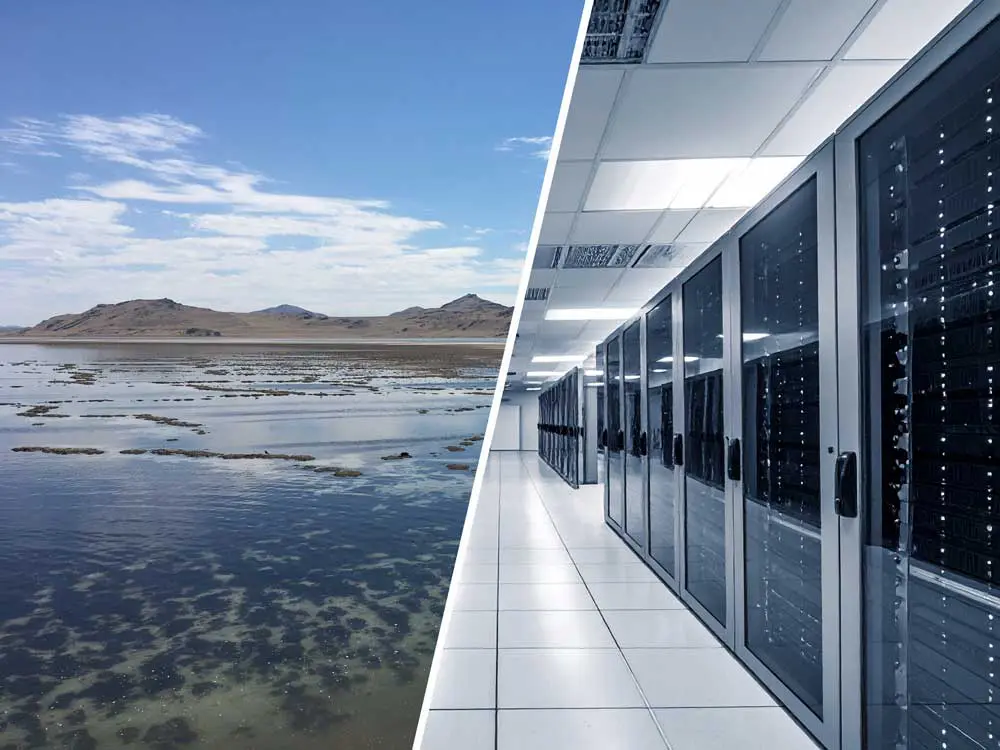
A massive proposed data center and energy development in western Utah is drawing increasing national attention due to its extraordinary scale and the environmental questions surrounding it. Known as the Stratos Project, the development would span approximately 40,000 acres — nearly the size of Washington, D.C. — in Box Elder County near the Great Salt Lake watershed. Supporters describe the project as a major investment in artificial intelligence infrastructure, energy production, and economic development. Critics, however, warn that projects of this magnitude raise serious concerns about long-term sustainability, resource consumption, and ecological impact in an already water-stressed region.
Approved in May by the Box Elder County Commission in partnership with Utah’s Military Installation Development Authority (MIDA), the proposed multi-decade development would include hyperscale data centers, large-scale on-site energy generation, and supporting industrial infrastructure. Promotional materials describe the project as capable of producing up to 9 gigawatts of power — an amount comparable to the output of multiple large power plants — while also supporting cloud computing, artificial intelligence systems, and national defense-related infrastructure.
Project supporters argue that the development would bring substantial economic benefits to northern Utah, including thousands of jobs, major tax revenues, and infrastructure investment. Developers also claim the project would operate independently of the public electrical grid by generating its own power on-site using natural gas from the nearby Ruby Pipeline. Public materials further state that the data centers would rely on advanced “closed-loop” cooling systems designed to recycle water and reduce evaporative losses.
Despite these assurances, environmental experts and local residents continue to raise concerns about the long-term consequences of placing a project of this scale within a fragile desert ecosystem. While developers emphasize that the cooling systems would use saline or otherwise non-potable water, critics note that even non-drinkable water sources remain part of broader regional hydrological systems. Water removed from the Great Salt Lake watershed still affects the watershed itself, regardless of whether the water is considered suitable for human consumption or agriculture.
Concerns surrounding the Great Salt Lake have become increasingly urgent in recent years as declining lake levels expose dry lakebed sediments capable of releasing potentially toxic dust into surrounding communities. Environmental researchers have warned that additional industrial water consumption — even if partially recycled — could contribute to long-term ecological stress within the region. Patrick Belmont, a professor of watershed sciences at Utah State University, described the proposed development as placing “the energy consumption of New York City in the middle of a fragile desert ecosystem on the shores of one of the most imperiled lakes in the world.”
Questions have also emerged regarding the project’s immense energy demands and the broader environmental implications of powering artificial intelligence infrastructure through large-scale natural gas generation. Although developers state the project will not burden Utah’s public grid, critics note that large industrial heat outputs and associated infrastructure demands may still affect surrounding environments and communities over time. Others have questioned comparisons suggesting the project could use less water than existing ranching or agricultural operations, arguing that such comparisons may obscure the larger issue of rapidly expanding industrial-scale energy and computing infrastructure in environmentally sensitive areas.
The Stratos Project reflects a broader national trend as artificial intelligence and cloud computing drive unprecedented growth in data center construction across the United States. According to the Pew Research Center, more than 1,500 new data centers are currently in development nationwide, many in rural areas where land and energy access are more readily available. As technological expansion accelerates, so too do questions about energy consumption, land use, water availability, and the long-term sustainability of increasingly resource-intensive infrastructure.
For Negative Population Growth, these concerns reinforce the importance of examining how continued technological and economic growth intersect with finite natural resources. Discussions surrounding sustainability must include not only population pressures, but also the growing environmental demands associated with modern infrastructure, energy production, and industrial development. Projects like Stratos highlight the need for thoughtful public dialogue about balancing technological advancement with responsible stewardship of land, water, energy, and ecological systems.
To read more on population growth in Utah, please visit NPG’s Utah page as well as our State Profile on the Beehive State.