

Population Pulse | Issue 34
- NPG
- July 2, 2026
- Population Pulse Archive
- 0 Comments
Battles Over Immigration Ensue

Just last week, U.S. District Judge Casey Pitts (San Francisco District) banned arrests outside immigration courts, renewing concerns over the handling of court cases involving illegal aliens. Referencing the Administrative Procedure Act of 1946, Casey states: “For 80 years, Congress has commanded federal agencies to think before they act.” He continues to say that the Act “does not require an agency to make the choice that a reviewing court might deem preferable. But it demands that an agency at least provide sound reasons for following its chosen course.”
In sharp contrast, an appeals court in Washington, DC, recently rejected a lower court’s order to end expedited removal, allowing the Trump administration to continue deportations without appearing before a judge. The main arguments against such swift action are that it violates our nation’s long history of due process and that serious errors have occurred, resulting in the deportation of legal residents. Some in favor of expedited removal claim that illegal aliens are not afforded due process because they are not citizens and that the number of errors is incredibly small compared to the number of legitimate deportations.
These examples prove how contentious our nation has become over illegal immigration. Part of our country believes immigrants – regardless of their legal status – have rights and deserve due process. Another segment believes that those in the country illegally – either by entering illegally or by overstaying their allotted time – should be deported immediately with no delay and no hearing. Adding to the division and confusion, activist judges on both sides of the political spectrum are now stepping in to either support the Trump administration or to hinder its progress.
NPG believes that illegal immigration would be a small fraction of what it is today had the nation adopted and consistently enforced border security measures and workplace enforcement legislation many decades ago. Instead, our elected officials have operated on a series of whims and political favoritism, allowing the numbers to fluctuate dramatically with each change in controlling political party. Our nation must negotiate and commit to true immigration policies that stand the test of time. These must include a firm cap on the number of legal admissions and an end to illegal entry and overstay by enforcing every means available, including the implementation of universal E-Verify for every employer in the nation. We must also return to a system of legislation passed by Congress, not a series of Executive Orders that can be reversed with the next change in party.
To review the article on the San Francisco District Judge, please click here.
To learn more about the DC appeals court ruling, please click here.

Please support our mission
with a monthly contribution to NPG.
Enrollment in NPG's President's Circle program enables your monthly gift to be processed with no effort on your part. Please click here to sign up.
This program is very beneficial to NPG as it helps secure a line of funding to support our normal educational programs, including our informative Forum papers and our thought-provoking advertisements.
We have many members enrolled in this program and we constantly hear how easy it is! Monthly contributions can be as low as $8 per month, although some contribute $50 or even $100 monthly! You can manage your participation online or with a simple phone call or email to NPG.
Please consider enrolling in this special program today! As a reward, we will forward to you an exclusive President's Circle lapel pin to help show your pride in NPG's efforts to slow, halt, and eventually reverse immigration-driven population growth!
Housing Booms Follow Rapid Population Growth
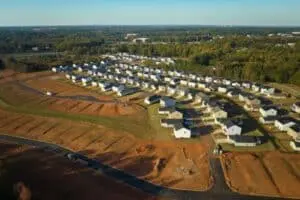
Across the country, communities are racing to build new housing as population growth continues to reshape local landscapes. In South Carolina, Jasper County led the nation in housing construction between July 2024 and July 2025, increasing its housing stock by 8.3%. Fourteen other South Carolina counties also ranked among the nation's top one percent for housing growth, while every county in the state added new housing during the same period. The construction boom has coincided with rapid population growth in communities such as Hardeeville and Moncks Corner, prompting local leaders to expand housing and infrastructure to accommodate an influx of new residents.
A similar pattern is unfolding in Central Texas, where the Austin-area suburbs of Liberty Hill and Dripping Springs ranked among the fastest-growing communities in the United States. Affordability and housing availability continue to attract newcomers, while developers are adding both single-family and multi-family housing to meet demand. Nearby, Williamson County also ranked among the nation's fastest-growing counties, adding more than 23,000 residents in a single year. Together, these developments highlight how population growth fuels an ongoing cycle of residential construction, infrastructure expansion, and land conversion.
These trends mirror the themes explored in NPG's Forum paper, Tomorrow's Tumbleweeds: Will 21st Century Boomtowns Go Bust?, by Mark Cromer. Examining the rapid rise of America's modern boomtowns, Cromer argues that today's housing and development surges are made possible largely because land remains available for expansion. As he writes, “The concentration of boomtowns in the American West... is perhaps best if simplistically reduced to a single word: land.” But he cautions that continued growth also brings increasing demands on infrastructure, natural resources, and quality of life, raising important questions about the long-term sustainability of communities built around continual expansion.
To read more about South Carolina, click here and here.
To read more about Texas, click here and here.
To read Mark Cromer’s Forum paper, click here.
Water Scarcity Fuels Tensions Across the West

Water shortages along the Colorado River are intensifying as negotiations among the seven states that depend on the river continue to stall. According to The New York Times, a prolonged drought, declining snowpack in the Rocky Mountains, and growing demand have left the river's reservoirs at some of their lowest levels in decades. With no agreement on how to divide the shrinking water supply, federal officials are expected to impose new water-use guidelines later this year, while several states are preparing for the possibility of lengthy legal battles over water rights. Approximately 40 million people and 5.5 million acres of farmland rely on the Colorado River, making the outcome of these negotiations critical for communities throughout the American West.
The dispute underscores how a water allocation system designed for the climate and population of a century ago is being tested by today's realities. Although cities and farmers have made strides in water conservation, persistent drought, rising temperatures, and continued population growth have placed increasing pressure on a river system that is delivering less water than the states are legally entitled to receive. As reservoir levels continue to decline, officials face difficult decisions over how to balance municipal, agricultural, and environmental needs.
These challenges echo the concerns raised in NPG's Forum paper, Under Pressure: How Population Is Putting the U.S. and Our Planet in Peril. Author Nathanial Gronewold notes that the Colorado River is being strained by the combined effects of climate change and growing demand, observing that “we also take too much water out of this system to keep otherwise unviable desert cities surviving and thriving.” As population growth continues across the Southwest, the paper argues that securing long-term water supplies will become increasingly difficult unless the underlying pressures on finite water resources are addressed.
To read The New York Times article, click here.
To read Nathan Gronewold’s Forum paper, click here.
To read more about Colorado, click here.
Climate Change Remains a Top Concern

Despite a lack of front-page coverage, roughly two in three Americans are concerned about climate change, according to polling data from Yale and the George Mason Center for Climate Change Communication. “Voting priorities haven’t changed much in terms of climate but other issues have leapfrogged over it, such as the Iran war, and the lack of coverage in the media means that people aren’t hearing or talking about it as much,” according to Anthony Leiserowitz, director of the Climate Communication Program at Yale.
As climate science continues to face serious skepticism from the White House, knowing that the majority of Americans show concern for our environmental future is encouraging. Unfortunately, however, the current push to “Drill Baby, Drill” and similar attitudes will prove very damaging over the next few years.
NPG’s hope is that our nation will one day adopt rules and measures to truly reduce harmful emissions and instill behaviors that help reduce the effects of climate change. Equally important, we want these new policies to remain in place for the very long term regardless of the personal ambitions of the sitting president. As one of the wealthiest and most educated countries in the world, we must serve as an example for climate policies and activism.
For additional reading on the topic, please review the source article from The Guardian.