Hawaii State Profile
- NPG
- April 28, 2026
- State Profile Series
- 0 Comments
OUR NATION’S ISLAND STATE
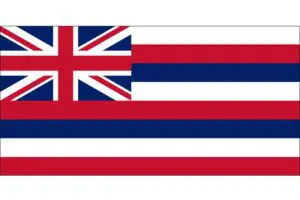
The Aloha State came into the fold of the US on August 21st, 1959. Before statehood, the archipelago had a long and rich Polynesian history with colorful stories of indigenous royalty and festive rituals. Beginning in 1820, Western standards of modesty spread through Christian missionary influence: the colorful Aloha shirt emerged decades later during the commercialization of ready-to-wear clothing.
There are many unique features of the last state to enter the union. It is the only state that is gaining surface area. Being a volcanic set of islands with an active volcano on the Big Island, Hawaii keeps getting reshaped. It gains an average of 40-42 acres of land per year due to the continuous eruptions of the Kilauea volcano. The 2018 eruption of Kilauea added 875 acres to the coastline, but at a steep price, more than 700 homes were destroyed. Lava flows do not immediately translate into arable soil. It can take from 100 to 400 years for nutrient rich soil to form.
Hawaii is an archipelago in the central Pacific Ocean. It consists of eight main islands, with 137 total islands in the Pacific Ocean state. The islands, formed some 30 million years ago, were created by active volcanoes. Active lava flows can still be witnessed by visitors to the Hawaiian National Park on the Big Island.
Captain ook, from Great Britain, was the first colonial explorer to attempt to reap its riches, but that didn’t end well for him. Tensions escalated in 1779, leading to violent clashes between Cook’s crew and Native Hawaiians. Cook was killed at Kealakekua Bay.
ISLAND POPULATION MATTERS
The state’s population was 1,446,146 in 2024. Most residents live on Oahu. Honolulu, its capital, offers all of the modern conveniences which is why one can find 70% of Hawaii’s population living on Oahu. At the time of the census in 1970, when the first Earth Day was celebrated on the mainland, Hawaii’s population was 748,182, just over half of what it is today. Included at the time were 58,000-armed forces personnel.
TROUBLE IN PARADISE
Over nine million visitors descend on Hawaii each year. They bring with them a very significant contribution to the local Hawaiian economy, estimated at over 20 billion dollars. The influx of tourists and a dependence on tourism mean that the islands direct their resources toward accommodating visitors. More hotels and recreation activities mean that the Hawaiian landscapes continue to change, and not for the better. The natural environment is altered and wildlife is threatened. Native Hawaiians are objectified and put on display for their exotic traditions which are exploited to keep attracting tourist dollars. Tourism pressure and the exploitation of native traditions have resulted in declining use of native languages and the loss of traditional practices.1
Each year 15,000 native Hawaiians move away from paradise. It’s not paradise when the cost of living gets too high for them. Growing tourism, population growth, and land purchases by very wealthy individuals are driving costs up on these isolated islands.2
The isolation from the mainland, the high demand for jobs and housing, and the low supply translate into living expenses that are 88% above the national average in Honolulu. Housing costs are 202% higher than in the mainland according to PayScale, Inc. The pressures of high demand and low supply often drive prices beyond the reach of the average person. Hawaii exemplifies this in the following statistics: The average home sale price in Hawaii is $955,000, while the median household income is $84,857, and the minimum wage weighs in at a mere $14.3
Ironically, populated islands are vulnerable to climate change and rising seas, while simultaneously depending heavily on the large carbon footprints of tourists for their economic viability. On average, roughly 30,000 tourists arrive in Hawaii each day, according to the Hawaii Tourism Authority. Air travel is a major contributor to climate emissions, with a single long-haul roundtrip flight producing about 1 to 3 metric tons of carbon dioxide per passenger—comparable to a significant share of a typical car’s annual emissions.
Tourism generates 25% of Hawaii’s economy but it is also Hawaii’s greatest source of environmental impacts. Tourists demand quality hotels and recreation amenities. This results in increases to cost-of-living, interest rates and home values. Meanwhile Hawaii’s economic infrastructure does not offer good paying jobs which would allow Hawaiians to afford homes there. In the 2020 census, 53% of Hawaiians were found to now live on the mainland.
Over 800 years ago, the first Kanaka Maoli or native Hawaiians settled on these isolated islands. They completely depended on ocean and land resources. Today only 20% of the fish consumed in Hawaii is actually from the oceans surrounding the state. Importing nearly all modern-day products and 80% of seafood creates a huge carbon footprint. In a healthy ocean, fish are the most renewable resource of protein. An example is the Opah Moon Fish which produces 300 million eggs a year, per pair. Because some reef fish spawn many times a day, they have the capacity to provide a much more sustainable source of protein for islanders, if managed properly.4
HAWAII’S AGRICULTURE AND LABOR HISTORY
Hawaii is made up of volcanic rock, mountains, and dense vegetation. Its volcanic soil is great for growing pineapple, coffee, and macadamia nuts, but 80-90% of their products must be shipped or flown in. Shipping is the main means of transportation, coming mostly from the port of Los Angeles.
Historically, the islands provide pigs, chickens, ginger, sugar, bananas, coconuts, sweet potatoes, and breadfruit. They also grow the root vegetable taro.
Long before statehood, between 1790 and 1870, whaling and sandalwood were both major parts of Hawaii’s agricultural industry. They are no longer viable industries, but both subjects are rich in history. Over the next 100 years, Westerners would bring in many other plants and animals that would become part of Hawaii’s rich but flawed agricultural history. Sugarcane was in use by Hawaiians long before Captain Cook ventured to the islands in 1778. As early as 1802, people on the island of Lanai were reportedly using stone rollers to crush the sweet juice from the sugarcane.
Sugarcane is a labor-intensive crop. With its popularity came a need for cheap labor. As sugar became a bigger and more lucrative business, it found itself needing more cheap labor. Hawaii’s relationship to slavery was somewhat different from that of the mainland. Labor to service the sugar industry came in the form of legalized coercion. The common people of the islands known as makaainana, were required to perform forced labor for the chiefs, typically six days each week. When that didn’t suffice, the Hawaiian government passed the Masters and Servants Act in 1850. The law permitted plantation owners to import Chinese, Japanese, Portuguese, and Filipino laborers under multi-year contracts. Native Hawaiian populations began to decline with the introduction of European diseases.
Many immigrants agreed to travel to Hawaii under labor contracts in hopes of improving their lives. However, what they found when they arrived were impossible working conditions. Cutting and carrying sugarcane, 10 hours a day, 6 days a week was backbreaking. Someven had longer, 12-hour workdays, with women doing some of the most difficult work, while getting only 2/3 of a man’s pay. Hawaii’s first wave of immigrants came from China in 1850. These workers served the plantation owners with the very cheapest of labor costs: $3.00 a month with a promise of travel, food, clothing, and housing. For this, they had to sign five-year contracts.
The arrival of Japanese, Korean, and Filipino laborers followed Chinese immigration to the islands. Diversity was used as a tool by plantation owners to sow discontent by offering different wages to each group. Suspicion and anger prevented these indentured servants from revolting or banding together to demand better working conditions. Eventually, a pidgin language formed among the laborers in an effort to fight the oppressive plantation owners.
Barely a step above slavery, indentured service was the name chosen for the enforced labor conditions in the Master and Servants Act of 1850. Just like in mainland slavery, people were severely punished for running away and coercive force was sanctioned by this law.
On June 14, 1900, Hawaii became a U.S. territory. This changed things for the better as the contracts with these oppressed people were immediately deemed illegal as they violated the U.S. Constitution. By 1946, more than 100,000 people lived and worked on the sugar plantations. A life-changing event happened that year with a successful 79-day strike organized by the ILWU (the International Longshore and Warehouse Union). It was the beginning of the creation of a more just society, but not until the 1968 Constitutional Convention was the right to collective bargaining addressed.5
THE CONTINUAL THREAT OF INVASIVE SPECIES
Because of their isolation in the middle of the Pacific, the plants that evolved on the Hawaiian Islands are 95% endemic, meaning they are not found anywhere else on earth. With colonization came the costly introduction of non-native plants and animals costing the economy millions and instigating disastrous consequences to the native flora and fauna.
Island ecosystems are delicate, and Hawaii is no exception. While population-growth inspired habitat destruction is the number one cause of plant and animal endangerment, invasive species are a close second in the Hawaiian archipelago. Hawaii has the infamous distinction of having more species on the Endangered Species list than any other state, while also being a site of tremendous biodiversity. Of the 100 worst invasive species (designated as such by the IUCN, International Union for the Conservation of Nature), half have already taken hold in Hawaii. A rather notorious invasive species is the mongoose. Native to India, these weasels were originally brought to the islands to control rats that fed on sugarcane in 1883. A poor choice and not scientifically vetted, they are now widespread and responsible for decimating populations of native birds like the Hawaiian crow and goose.
MAKING SURE ALOHA DOESN’T MEAN GOODBYE
Islands are an ideal study site for sustainability. The borders are well defined and therefore limits are easy to observe. Hawaii’s beauty is constantly being threatened on many fronts. Its beauty attracts more people than it can hold, while its location in the middle of the Pacific makes it environmentally costly to migrate, tour, and maintain. Its fragile nature needs to be protected under conservation policies which include limits to expansion of its numbers and subsequent development.
THANK YOU
Thank you for reading NPG’s 22nd State Profile! This series was created to help draw attention to the effects of population growth across the country by presenting state-specific information in an accessible format.
NPG remains committed to educating the public by providing academically-sound information related to population size and growth. While lower birth rates have contributed to some progress, recent political trends have largely offset these gains.
We encourage you to use NPG’s State Profile series as a resource—whether writing Letters to the Editor, engaging with local officials, or participating in community discussions. As the series continues, we remain dedicated to supporting informed dialogue and action at the local level.
NOTES:
- https://pressbooks.library.upei.ca/artsreview-xi/chapter/trouble-in-paradise/
- https://www.cbsnews.com/news/hawaii-native-hawaiians-moving-cost-of-living/
- https://medium.com/berkeleyischool/the-impacts-of-living-in-paradise-a-narrative-study-on-the-native-hawaiian-migration-trends-5ba79cff89f0
- https://dlnr.hawaii.gov/wp-content/uploads/2024/05/F-6T.pdf
- https://www.uhpa.org/monday-report/dont-let-history-repeat-itself/
- https://dlnr.hawaii.gov/hisc/mongoose-urva-auropunctata/