
Tomorrow’s Tumbleweeds: Will 21st Century Boomtowns Go Bust?
- Mark Cromer
- February 25, 2026
- Forum Papers
- Forum Paper
- 0 Comments
Click here for a downloadable, printable PDF version.
An NPG Forum Paper
by Mark Cromer
February 2026
ABSTRACT
Boomtowns are an iconic feature of America’s history, one that often hews to a familiar template: a small burg is rapidly transformed to a bustling center of commerce, usually following the discovery of a precious metal or a fossil fuel. In some notable instances, the boom turned to bust seemingly just as fast. The skeletal remnants of some boomtowns are ingrained in the American iconography of the Wild West with names like Calico and Tombstone. The grim implosion of the once thriving ‘Motor City’ during the latter half of the 20th Century offers a modern warning that no city is too big to fail. As 2026 gets underway, cities and regions across the United States are again experiencing explosive growth in unexpected places that is altering landscapes and lifestyles, with Big Data driving much of the development. Will the harsh lessons of the late-19th and mid-20th Centuries come to pass again? Have the civic leaders learned from the historic boom-to-bust cycles? Or is it in America’s sociocultural genetics to keep building and consuming in a freewheeling dynamic that’s consistent with a casino table—keep rolling the dice until our luck runs out?
“Boomtowns? Hell, we’re no different than Tombstone, Dodge City or San Francisco. First comes the dreamers, then the bankers, then the salesmen. Then the sharks, then the desperate and then the thieves…and nobody is immune. Kids have to quit college. Trucks get sold or repo’ed. Houses too. People quit going to the doctor because they lost their insurance. Yeah, a bust affects everything in a town like this, even the lifespan of the population.”
—Billy Bob Thornton, Landman
The above monologue, as uttered in the syrupy Southern drawl of actor Billy Bob Thornton, packs a particularly powerful punch at the opening of 2026.
The world’s powers continue to prosecute their tussles over oil reserves known and unknown in places like Venezuela and chase each other over rare earth mineral rights across the globe to the frozen terrain of Greenland. Meanwhile, the American national backdrop appears increasingly stuck at full boil and adorned with ugly flourishes of violent political discontent and deep polarization of the type that inflicts unhealing wounds across the body of Americana that now stretches from The Twin Cities to Los Angeles.
And through all of this global competition and domestic upheaval, the American national landscape is once more being transformed by boomtowns, rapidly expanding population centers that are fueled by dazzling technological advances of the sort that herald great promise in the future but carry with them the echoes of the greed-fueled speculative impulses of the past.
The formative dynamic of the boomtown can be seen in that cycle of habit.
In the hit drama series Landman, Thornton plays the character Tommy Norris, a hardscrabble petroleum ‘Landman’ who has a standard C-Suite title for his position at the fictional petroleum company M-Tex Oil, but who in actuality operates as an all-purpose fixer for the second-tier oil outfit. Thornton’s portrayal of a chain-smoking Norris comes across as a blend of T. Boone Pickens and Tony Pellicano as he navigates the potentially deadly perils of drilling to the omnipresent threats of the narco-cartels that operate their own multibillion-dollar ventures across the same Southwestern real estate. And, he does it all while ensuring the oil wells deliver the crude that remains fundamental to life as we know it in the first quarter of the 21st Century.
Thornton’s character is an amalgamation to be sure, and an exaggerated one at that, but his ever-present weary voice throughout the storyline of Landman is ultimately a narration of indisputable truths, cold as they may be, about human mass consumption and our national psyche that has long been grounded in something akin to a kid in a candy store.
Through Thornton’s jaded prism of perspective, viewers are led to the paradox: human mass consumption sometimes leads to booms, but human mass consumption also leads to busts.
Landman debuted on Paramount+ in November 2024 and quickly became a hit, in the process opening viewers’ eyes to the harsh realities of the search for oil; locating it, extracting it, the refinement of it and all the way down the pipeline into the vast retail public interface at the pumps in the nearly 160,000 gas stations that are ingrained across America.1
It is a grim business top to bottom; one that stretches from the heartbreak and rancor that’s omnipresent throughout the ‘man camps’ that house the roughnecks out in the middle of the Texas desert—all the way up to those executives, who face their own kind of defilement constantly lurking amid the byzantine financial vehicles that are cobbled together with seemingly little more than gossamer and pixie dust in the gleaming glass towers that encase the corridors of petroleum power in Austin, Houston, Dallas and Ft. Worth.
Set in the Permian Basin that runs across parts of New Mexico and Texas, the terrain in Landman sits atop the highest producing oil field in the domestic U.S.—which it is in real life just as it is presented in the series—and one that revolves around the town of Midland, Texas.
Located in the lower western region of the Texas panhandle, the city of Midland was a small town itself of the four-digit variety until the 1950s and 60s rolled around and the town saw triple-digit population growth approaching 190% by 1960.2 Today, Midland’s population hovers around 140,000 people and the city’s roster of top employers makes clear that the liquid gold of oil is still king, with Chevron, Exxon, Halliburton, Occidental Petroleum and Conoco Phillips among many other energy companies maintaining operations3 in the city whose motto is: “Be The Energy!”
Paramount’s series has garnered critical raves for its A-List lineup of thespians, who, along with Thornton, includes Demi Moore, Andy Garcia, Jon Hamm, and Sam Elliott. But the drama’s real artistic heft is delivered through its unflinching portrayal of the tides of fortune and misfortune as humankind’s addiction to fossil fuels proves to be as an impossible habit to kick as Thornton’s blizzard of cigarettes, even as the human footprint continues to grow rapidly across the nation and the planet.
With the dependency on oil comes the tidal flow of humans that will inevitably follow even the most illusory prospect of claiming a fast fortune, which in this era can quickly turn into a Texas flashflood. The cruel realities of mass consumption of vital finite resources—be it oil, water, minerals or arable land—are all front and center throughout the series as Thornton’s rough-hewn Norris zigzags his way across the Texas landscape that is alternately grimly bleak and breathtakingly beautiful.
And all the while, Norris is taking stock of a Wild West-meets-Wall Street party that he understands is going to come to a hard, sudden end. One begins to have the feeling that Thornton’s character Norris is himself merely a walking metaphor for the boom-to-bust cycle, his perpetually exhausted state and autopilot-like navigation from dawn to dusk suggests a vortex that’s dragging him inexorably to his date with destiny, and everyone else with him.
Tracking 21st Century Sonic Booms
While the Landman series is a fictional storyline that’s cast with at least ostensibly fictional characters, as noted before, the actual landscape and its humming dynamics are indeed very real. Across Texas, there are towns that have experienced sonic-boom level growth, though not always because of oil.
What actually constitutes a boomtown depends to some degree on whose metrics one uses and over what time frame those measurements are applied. Merriam-Webster defines it with simplistic accuracy: “A town with a sudden surge in business and people.” But the more holistic definition is somewhat fluid and most reasonable people would agree that ultimately it is a designation that rests partly in the eye of the beholder: they know a boomtown when they see it.
And they especially know a boomtown when they suddenly find themselves living in one: When that 10-minute ride between their freeway offramp and their driveway becomes 20 minutes and then almost 40 minutes, all in less than a year.
The analytics and intelligence firm Checkr, which provides a wide range of services ranging from Department of Transportation verifications to healthcare sanction searches, published a detailed assessment of the ‘Top 100’ boomtowns in the United States in the summer of 2023. Among the key factors the firm applied to gauge whether fast-growing towns were actually booming, were population growth, GDP growth, the unemployment rate and workforce health, expansion of housing units, personal and per capita income and changes in the median age, among others.4
The company compiled and analyzed data from every one of the 381 areas that had been classified as ‘metropolitan’ by the U.S. Office of Management and Budget in 2023 and weighed the associated factors with ‘booming’ against their size (size alone does not establish a ‘boom’) and attempted to discern which ones qualified and to what degree, establishing a ranking system.
In the resulting Top 10 that the Checkr analysis produced, four of the Top 10 boomtowns in the United States by 2023 were in Utah, including the number one boomtown of Provo, which was joined by St. George at number five and Logan and Ogden as numbers eight and nine, respectively. Idaho was the only other state that had more than one city in the Top 10, checking in with Boise City at number two and Coeur d’Alene at number three. Cities in Oregon, Florida, Texas and Nevada filled out the rest of the top tier.
Notably, the analysis conducted on boomtowns emerging across the country also produced a list of the slowest growing cities in the United States, a designation that appears weighted primarily in eastern and southern regions of the nation and with a few locations in the Midwest. Absent completely from the Top 25 slowest growing cities in the United States, however, was the American West: California, Oregon, Washington, Arizona, Nevada and Colorado did not account for even a single entry on that roster of civic slugs, one that stretched from Illinois (which had five cities on the ‘slowest’ list) to Pennsylvania (three cities listed) to Louisiana (three cities listed) and included cities in Indiana, Ohio, Wyoming, Arkansas, Missouri, Alabama, West Virginia, Texas, Oklahoma, New Mexico, New York and Maryland.5
The concentration of boomtowns in the American West and its apparent immunity from joining the slowest growing cities across the nation is perhaps best if simplistically reduced to a single word: land. A constellation of other considerations applies here, of course, ranging from environmental regulations to the tax benefits available in various regions and locales to the captains of industry that drive development, but none of those are relevant without the raw real estate on hand to facilitate further growth of human civilization.
Texas-Sized Growth in Once-Small Towns
One of the most notable boomtowns to arrive with an explosion of population growth in the 21st Century is Frisco, Texas, which for the better part of a century had remained little more than a dusty speck due north of Dallas and Ft. Worth. What had been a stopover for pioneers that were settling in what is now Dallas in the 1800s, by the time the 20th Century got underway, Frisco City (as it was then called) was home to a resident population of about 300 people. The town took the first iteration of its name in honor of the railroad line that had connected St. Louis to San Francisco.6
For the next 80 years, precious little changed for the residents of Frisco as the 20th Century passed by with two world wars that were interspersed with The Great Depression and the Dust Bowl and life went on. But, as the 1990s began, the farmland and scattered homes of Frisco increasingly became a destination for developers looking to create new residential enclaves within reasonable reach of the Dallas-Ft. Worth metro area.
The town had a population of about 6,100 in 1990, but by the time the Millennium arrived it had grown to 33,700, a stunning 450% growth rate. A decade later, and 117,000 people would call Frisco home in 2010, a dizzying growth rate of nearly 250%. By 2020, Frisco’s smalltown history was indeed history, lost somewhere deep in its civic rearview, with a population of 200,000 people calling it home. While that growth rate signified a pumping of the brakes, as appropriate land to develop became less easily available, by the end of 2024, Frisco had again added another 17% on top of that and reached 235,000 people.7
In other words, the once tiny collection of ranches and farms that was Frisco, Texas, has, in just three decades, transformed into a population center twice the size of the port city of Tacoma, Washington.8 By any estimation, Frisco’s growth amounted to a massive sonic boom—cumulative over time, but sudden in its effects. The town’s history has been, in many respects, not so much transformed by the boom but rather buried by it, as much of the rich farm and ranch land of Frisco was simply sold off, paved over and built out.
Central to the explosive growth of booming Frisco is its financial underpinnings that flow from the neighboring Dallas-Ft. Worth Metroplex, the mighty region is the fourth largest metro area in the United States9 and sits like a proverbial sea of oil lurking beneath a geological formation that can be harnessed to support growth—at least for the time being. The economic factors that allowed explosive growth in Frisco are not located in Frisco, but are within the driving distance of the daily commute. The DFW Metroplex has a relatively deep reserve of upper-income producing employment beyond the big energy sector, including aviation, telecommunications, financial services and electronics manufacturing. That employment base in just those strata alone accounted for more than 250,000 jobs, all of which provide annual average wages of more than $100,000.10
And, that’s how a backwater ranchland that was just a stone’s throw from the suburbs of Little Elm and Lake Dallas, both within the DFW Metroplex, was transformed by a boom that began in the commercial corridors running alongside of Interstate-35E and rippled north into the once vast and golden wheat fields and pasture lands that gave Texas its Texas reputation in the popular imagination.
Boomtowns Abound
The Lone Star State is not the only area of the American South that has seen boomtowns erupt in recent years, with explosive growth transforming parts of the Old Dominion as well as the Sunshine State. In Virginia, Loudoun County has been remade from a largely rural landscape with substantial Civil War-era significance into a suburbanized region that’s being fueled by Big Tech. In 1990, the population was 86,000, but by 2000 the county had grown to nearly 170,000, marking a 96% increase in the population. That was just the start of it. By 2010, Loudoun’s population had spiked to 312,000, another 84% growth rate, and then raced past 420,000 people by 2020, another 35% in population growth.
Northern Virginia has been a hotbed of technology development for some time now and the explosive growth seen in Loudoun County has been supported in part by Big Tech—the county is home to the world’s largest concentration of data centers resulting in 15,000 jobs—but it has not been completely tethered to it. Verizon also employs thousands of workers in the county, as does Northrop Grumman and Raytheon, both major manufacturing outfits.11
In Florida, St. Lucie County sits on the eastern coast of the peninsula, nestled between Vero Beach to the north and Palm City to the south, and for the first half of the 20th Century it was like much of the rest of the state, a sun-splashed stretch of palm lined beach and swampy land the further you moved inland. But by the time Eisenhower was moving into the White House, developers were bringing new home buyers into St. Lucie County at a pace that nearly doubled the population every decade between 1950 and 1990, when it had more than 150,000 residents calling the county home.12
Beginning in 2000, however, the population growth began to diminish as an overall percentage, but even 30% to 40% growth translates into massive increases in the number of people jammed into the 572 square miles of land that make up the county. Thus by 2025, even with marginally declining percentages of actual growth, St. Lucie County was approaching 400,000 people living in it by last year.
If Texas and Virginia offered raw land to build on, in Florida—as just driving through any of its eastern peninsula coastline communities will reveal—the developers are building up, not out, making some areas of the state look increasingly like Vancouver, Canada, which has been completely transformed by a forest of skyscrapers and residential towers.
Are Data Centers the New Oil Rigs?
While the debate over whether humanity has hit ‘Peak Oil’—a term used to define the pivotal moment in modern history when the global supply of oil has exceeded its maximal extraction levels and begins its descent into that of a dying commodity—and how much longer fossil fuels will remain a viable industry at present scale is far from over, the new generation of boomtowns popping up all over the United States today are more likely to be the result of Big Data than Big Oil.
In Virginia’s Loudoun County, technology’s footprint is increasingly looking like Godzilla, taking up 49-million-square-feet with data centers alone, according to the county’s economic development council.13 With its much-hyped Data Center Alley, the county has more than 200 data centers that were operational at the dawn of 2025 and more than 100 on the boards and coming online in the near future.14 To put that in perspective, the Houston Metroplex has more than 50 data centers operating and more than 300 data centers are either operating in Texas or about to come onboard, which means the entire Lone Star State is just catching up to Loudoun County.15
Put another way: There are more data centers in Loudoun County than there are in Beijing and Shanghai combined.16
In Umatilla, Oregon, what once was a small outpost nestled alongside the Columbia River has seen big changes sweep through its town after Amazon launched a building spree of massive data centers in the northern region of The Beaver State.17 The data centers are the driving force behind the population growth now rolling over the region and also the source of growing concern among the locals that see a buzzing economy coming with a very distinct decline in quality of life for residents.18
Wherever data centers and other accoutrements supporting Big Tech arrive—the surge of money, construction, jobs and people into a given area and those adjacent—increasingly there is attention being given to what remains after the buildout, beyond the increased traffic congestion and the disappearing natural landscapes.
The buzzing that residents are hearing isn’t all in their heads.
Data centers all over the nation and particularly in boomtowns like Ashburn in Loudoun County have drawn concern over the ambient noise level the centers produce nonstop, round-the-clock. As a report in the BBC put it: “When you cross into Loudoun County, Virginia, one of the first things you notice is the hum—that’s the sound of 199 data centers whirring in the background.”19
Along with the footprint and the noise pollution, there’s also the matter of the energy-suck of data centers and there’s no way around describing each center to be essentially the equivalent of a small star collapsing into a Black Hole that devours every watt that it can as it powers its servers and all the associated equipment that centers need to operate—with cooling systems being a critical component.
All in, a modest to larger scale data center can consume enough energy to power tens of thousands of homes annually. For a better perspective still, data centers in the U.S. consumed 183 terawatts of energy in 2024, enough juice to meet the needs of Pakistan and its 250 million people. In just four more years, the U.S. is on track to grow its data center consumption rate to 426 terawatt hours.20
The figures and the potential civilizational fallout from the impacts are, without exaggeration, staggering. And there is widespread acknowledgement of this from virtually every corner, including wide-eyed proponents of all things AI, an acknowledgement that is also accompanied by a sense that the train has left the station and we’re all taking the ride.
And that brings us back to the familiar habit of considering social policy through the lens of pop culture. The long-running conventional wisdom that the debate over climate change and global warming is over may still mostly hold true, but Hollywood has long been a keen barometer of the public atmosphere and the wind that is presently blowing carries with it a rising skepticism of clean energy initiatives that had been thought sacrosanct.
In Landman, Thornton’s character held forth in a rant that went viral as he shed a little more light on the facts surrounding the finite resources predicament that Americans and the rest of humankind around the globe presently find themselves in.
Gazing upon the giant turbines of a windfarm out in the hinterlands of Texas, Thornton offers a cold retort to what the wind energy movement means in connection with Big Oil and the fantastical idea that turbine-generated energy can somehow quickly replace it as our primary source of energy.
“There is nothing clean about this,” Thornton’s character Tommy Norris snorts. “Do you have any idea how much diesel they have to burn to mix that much concrete? Or make that steel? And haul this shit out here and put it together with a 450-foot crane? You want to guess how much oil it takes to lubricate that thing? Or winterize it? In its 20-year lifespan it won’t offset the carbon footprint of making it. And don’t get me started on solar panels or the lithium in your Tesla batteries. And never mind if the whole world decided to go electric tomorrow, we don’t have the transmission lines to get the electricity to the cities. It would take 30 years if we started tomorrow.”
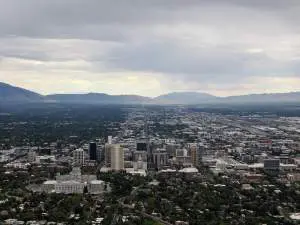
Salt Lake City Booming Blues
There are more than a few reasons that Utah repeatedly lands on the ‘fastest growing’ fill-in-the-blank list year after year, and why four out of the Top 10 boomtowns in America today are located in the state. Again, Utah dominates that list more than any other state.
Anyone who has driven Interstate 15 between St. George in Southern Utah, passing Provo and up to its capital of Salt Lake City, can see the dramatic development that does appear to be spreading everywhere. Much like the verdant fields and ranch lands in Texas that have disappeared in places like Frisco, all across Utah there are farms and fields and wild stretches of picturesque landscapes that are literally here today and gone tomorrow.
Every resident living in the state and every driver passing through it has seen the sprawl of insta-communities and the gleaming corporate centers and technology campuses that have appeared seemingly out of nowhere.
The explosion of development may be propelling Utah to dominate in its class of boomtowns, but as some longtime residents are making clear, the bulldozers and cranes that come with it may be around for lifetimes to come.
Tom Clyde, a lawyer practicing in Park City who has long had his finger on the pulse of Utah’s socioeconomic landscape and its growth patterns, took to the pages of The Park Record newspaper (where he has been a contributing columnist since the 1980s) to sound the alarm over the booming boomtowns.
“It is no secret that housing is in short supply in most of Utah. The local market is especially out of whack, as resort communities often are. The rest of the state is also bad, with tight availability and high prices,” Clyde wrote.21 The numbers now confronting the Beehive State in relation to squaring its available housing stock with the demand for residential units are nothing short of daunting.
“Between now and 2050, the state estimates that we will need 842,000 new housing units,” Clyde noted, setting up the punch line. “At the current rate of building, which seems pretty brisk, we will be 200,000 units short of that. That’s a lot of building.”22
That’s an intentional understatement, but one Clyde makes the most of as he considers that this type of growth keeps its own momentum without end right up to the point of collapse.
“So, we need to nearly double the number of grocery stores, schools, hospitals, strip malls, sewer plants and so on to make it all function. New roads, new rail lines, power plants and all of it. More land paved over,” Clyde wrote. “And there’s no guarantee that all of that will bring the actual price of a house down. All that new infrastructure will be expensive and has to get paid for somehow. It’s a bit overwhelming…and as we have learned in Summit County, the legislature can change the rules to get what they want. So, what does it all mean?”23
Clyde answers his rhetorical question by stating the break-neck paced buildout in Utah will signify in no uncertain terms that the state’s leadership has thrown in the towel on efforts to save the Great Salt Lake and prevent it from its final evaporation. “You can’t add 2.5 million people and urbanize several hundred square miles of land without increasing water consumption. So, the lake is toast.”24
The legislature in Salt Lake City is poised, according to Clyde, to demolish local land-use restrictions that smaller cities have used for generations to maintain their civic character and manage their own growth. Since local restrictions have proven to be one of the last substantial bulwarks holding back a frenzied development scheme of ‘Build, Baby, Build,’ Clyde believes the brain trust in Salt Lake City—dominated by legislative and developer interests—has determined not to limit local restrictions but rather flatten them with a steamroller.
One ominous bureaucratic workaround that has already been utilized in Utah is a designation called “preliminary municipalities.” The phrase is legislative language that has all the intended vagueness of a Soviet-era diplomatic cable and one that allows landowners and developers to incorporate their own non-existent towns—or “pretend towns” as Clyde calls them. They then draft their own zoning rules that allow landowners to play make believe with density schemes and infrastructure requirements that nonetheless will have very real-world impacts on the surrounding communities.
Put more simply: “preliminary municipalities” essentially means just go ahead and build it and then worry about infrastructure needs and regional impacts later—just do it. If the fake cities come to life as Frankenstein’s monster teeming with more people than is supportable, well, it will be up to the county and state governments to figure out what to do about it then.
State leaders in Utah have begun to put the brakes on such communities while grandfathering in some of the early ones in Park City and Kane Creek.25 The fact that an entire state was suddenly-if-briefly opened up for a private property development bonanza with make-it-up-as-you-go-along rules should be a warning shot heard ‘round the nation.
“It’s clear that the powers that be think that doubling the state’s population is not only inevitable but desirable,” Clyde writes. “The legislature is not about to let anything get in the way, not even real physical and environmental restraints.”26
Clyde closes his appeal to pump the brakes across Utah and prevent the state from being overwhelmed with boomtowns and new towns and myriad other communities from springing up overnight with a stark warning that succumbing to population growth pressures will soon render the state unrecognizable. “Gov. Cox may not want his kids to live in Indiana, but when this development binge is over, they might prefer it.”27
Boomtowns Today, Ghost Towns Tomorrow?
The future sure isn’t what it used to be, that much seems widely accepted across the country, as technological advances continue to accelerate and are transformed into various realizations with ever greater levels of capitalization. Whether the wild building sprees will eventually burn themselves out like a natural wildfire after it consumed all of the fuel it needed to keep blazing remains to be seen.
But the boomtowns will remain for now, their future viability predicated almost completely on unknowable market trends and unanticipated factors.
As 2026 unspools and these advancements are being implemented, a news report in The New York Times spelled out the emerging market confidence that A.I. will be not just a fundamental force propelling the economy in the decades ahead, but rather the fundamental force that drives America’s economic engine for a generation to come.
“In the end, the rally came down to one big idea: that artificial intelligence will be a generational force underpinning the stock market, because of the scale of investment needed to build the infrastructure that powers it and the technology’s expected productivity gains,” journalist Joe Rennison reported. “By one measure, more than 90 percent of economic growth in the first half of 2025 came from investments in computer equipment and software, which economists chalk up to projects linked to the rush to build data centers and remain in the A.I. race.”28
The financial features surrounding the A.I. boom are becoming the stuff of fantastical appraisals, with semiconductor manufacturer Nvidia seeing an increase of its market valuation to $4.5 trillion by the dawn of 2026 and analysts ascribing 15 percent of the S&P 500’s entire return last year to the company.29
For perspective, consider that at the dawn of this year, General Motors Co. had a market valuation of $77.5 billion, Ford had a market valuation of $53 billion, General Electric had a market valuation of $327 billion and Boeing was valued at approximately $170 billion.30
Trillions are being poured into a sector and a line of technology but no one is quite sure what exactly it will result in. And no one is quite sure how it will affect the physical landscape, energy consumption and employment of huge swaths of the American labor market. As for boomtowns, there can be little doubt that they will continue to emerge across America, driven by data centers and other presently unknown variables that are sure to emerge. We should remember that a decade ago few people were talking about data centers or calculating their impact on the nation. New factors that we had not previously considered will make their presence known in the years ahead. Whatever the driving forces are, boomtowns will be with us as more and more people compete for space, resources and some semblance of a decent quality of life.
Continued population growth is not unlike oil: it factors into virtually everything we do.
As Tom Clyde pondered in The Park Record just what it meant for the grandkids, Thornton sums it up quite well in Landman.
“And unfortunately for your grandkids, we have a 120-year petroleum-based infrastructure, our whole lives depend on it, and hell it’s in everything: that road we came in on, the wheel on every car ever made, including yours, it is tennis rackets, lipstick, refrigerators and antihistamines, pretty much anything plastic, your cellphone case, artificial heart valves, any kind of clothing that isn’t made with animal or plant fibers, soap, hand lotion, garbage bags, fishing boats, you name it. Everything,” he growls. “And you know what the kicker is? We’re going to run out of it before we find its replacement.”
For footnotes please refer to the PDF of the Forum paper by clicking here.








Mark Cromer is a professional writer and researcher with more than three decades as a working journalist and an investigator in the field of business intelligence. His work on mass immigration and population growth issues has been published in major newspapers across the nation and internationally. Cromer was a senior staff investigator at Sapient Investigations, Inc., for more than a decade and he worked as a contract investigator for Kroll Associates, the global blue chip risk consulting and investigations firm.