
Out of Touch with Reality: Why the World Won’t Blame Overpopulation for Climate Change (NPG Book Review)
- Dr. Karen I. Shragg
- February 25, 2026
- Forum Papers
- Forum Paper
- 0 Comments
Click here for a downloadable, printable PDF version.
An NPG Book Review
by Karen I. Shragg, Ed.D
February 2026
A REVIEW OF
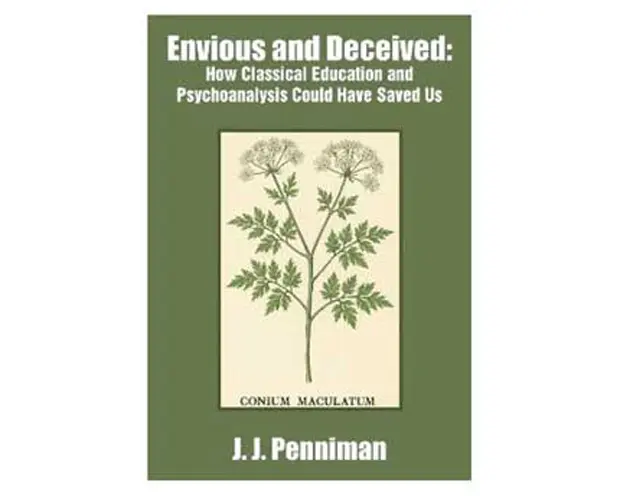
Envious and Deceived: How Classical Education and Psychanalysis Could Have Saved Us
by J.J. Penniman
Washington, D.C: Academica Press, 2025. 208 pp. plus Glossary

This new book offers consolation and validation to those who have been consistently ignored about the seriousness of the overpopulation issue. With a drawing of poison hemlock on its cover and a title hinting that we have missed our opportunity for saving ourselves, this book by J.J. Penniman fascinates. The perspective he chooses for this deep exploration of two philosophies is from that of a historian, that is if we were looking backward from the future. Before one gets knee-deep into the book, one can sense the great intelligence of the author. Not many can successfully teach themselves both Latin and Greek in order to master a topic. Penniman did just that. The author asks himself deeply introspective questions and develops an analysis that stuns and often overwhelms, all the while leading us on paths of new ways of thinking, which is the most noble of goals for any non-fiction book.
There are many ah-ha moments throughout this unique book. They offer insight while also opening the door of regret and melancholy for the paths not taken. I have long thought that critical thinking was missing from our educational system, so it was soothing to read that Penniman lays the blame for our dismal record of making sustainable choices on our lack of focus on what he refers as a Humanist education. The goal of Humanist teachings is to improve our mental health by enriching our knowledge of how the world works. With more keen insights of learning about both the “inner and outer worlds,” we might have been able to avoid the “pitfalls of collective self-deception.”
Penniman argues that our first line of defense against our current predicament should have been to embrace the act of critical thinking, as practiced by the philosophers of Ancient Greece. Through dialogue and self-reflection, as a means to enlightenment, Penniman theorizes that we could have become more socially and ecologically responsible. While this would be a huge accomplishment give the state of education today, this would eventually fade and he predicted that humans would go back to their lives of self-deception.
To Penniman, what was needed was a reinforcement strategy that would keep our unconscious mind from the grip of denial and repression Penniman is both an amateur Classics scholar and a psychoanalyst. He believes that both of his disciplines could have saved us if applied together. Psychoanalysis, he posited, is just such a strategy for it offers an assurance that we would not fall victim to our tendencies that impede progress.
This book puts humanity on the psychoanalyst’s couch in order to explain our inconsistencies when it comes to global problem solving. He rightly accuses those who are warning us about climate change without mentioning the role of population as being out of touch with reality. Penniman chides environmental activists when their warnings about losses of bee and bird populations do not include the role of human overpopulation. It is the fundamental reason behind the downfall of biodiversity. He pins this avoidance on the association he believes we have between depopulation and “attacks on the unborn.” How insightful to connect the unconscious mind with the almost universal revulsion to even voicing the idea that there might be too many people on the earth.
Our psyches are desperate, filled with envy and anxiety, which he calls, “envy-fear.” To compensate, humans are seduced by the desire of unreachable omnipotence, which implies invincibility. The resulting technological success perpetuates growth which in turn must be justified in order to keep it going, even though that in and of itself is unsustainable. The author believes that our common strong desire to become parents and to demonstrate parental love to be the reason many find comfort in the concept of open borders.
“Reaction formation” is what Penniman believes is at the heart of it all. He explains that it is an exchange of opposites, in other words it is a denial of “badness” by overcompensating with “goodness.” An example of this is the “hatred of overcrowding, while at the same time exalting the cults of parenthood, maternal love, universal benevolence and above all unconditional inclusion.” In other words, we will overcompensate for knowing we cannot keep growing (in numbers) by making sure we keep growing. This seems like the perfect definition of insanity. For example, we go out of our way to make sure we are on a path of destruction while deluding ourselves that increasing immigration is somehow a good thing.
This may be of some comfort to those of us who struggle to work on introducing common sense policies of sustainable migration. It may also cause others to throw their hands up in the air when they recognize the entanglement of psychological barriers which prevent our success
For years I have wondered why rational people avoid connecting the dots in what seems so scientifically obvious; on a limited planet there are limits to growth. But the unconscious mind, this book asserts, is not the rational part of us. I am not a student of psychology or its various branches, but perhaps I should be, for it may just offer an explanation that would leave me, and others like me, much less bewildered.
The challenges to address our environmental woes are typically pursued by those who care, not those willing to obliterate the last remaining wilderness for a few drops of oil. Penniman offers almost soothing answer: we have been creating the petri dish of denial with our weak education system and unwillingness to address our deep-seated psychological barriers to absorbing the truth of overshoot.
As he says in the book’s introduction, “Although the public rails rightly against climate change, it ignores its root cause, overpopulation.” This has been my personal experience on countless occasions. Envious and Deceived just may have uncovered the mystery of why my head has been shaking back and forth in utter dismay and confusion over years and years of speaking and writing on this topic. He puts the blame on “deep psychological forces,” for what he refers to as a “fatal selective inattention to overpopulation.”
In what felt like a jolt of clarity, Penniman announces using his gifts of deep scrutiny that, “we associate depopulation with attacks on the unborn.” As illogical as it appears to a critical thinker, what really matters is how we react to it at the deepest level. This explains — better than anything else I have heard — the negative reaction to some of my overpopulation talks. When trying to explain the role that overpopulation plays in our environmental woes the frequent negative reactions have never seemed rational. I assumed it was tainted by monotheism which has portrayed the earth as a part of a grand plan by a deity. Penniman offers another perspective. He claims it goes deeper than that, and points to a connection that is hard to explain in any scientific way. In the book he claims, “We were busy fleeing tensions and chasing omnipotence which sealed our doom.” It wasn’t a rational response to a problem, it was our dysfunctional psyche.
After describing what he sees as the problem, Penniman takes us on a fantasy ride. What if we would have embraced a very different journey? What outcomes would have been different? He refers to his imaginary world as The Republic of Mental Growth or RMG. In this Republic, public school would be mandatory, and it would introduce Latin and Greek words along with classical grammar and the concept of psychoanalysis. His Republic would be unique on a whole different scale, all intended to keep us away from the worst impulses of human nature. Schools would be small by design and sophomores would be required to enter psychoanalysis. The success of RMG means society would have to depopulate first, for it requires small institutions to maintain its goals. Society would be race-neutral but not culture-neutral. Its reduction would be based on numbers not on race, by attrition not by violence. He quotes a woman with whom I am acquainted and is quite wise about matters of race and overpopulation work. Florence Blondel from Uganda is an overpopulation activist. She works for Population Connection. She publicly scolds those who speak up against getting involved to help Ugandan’s control their total fertility rates due to some fabricated notion that it is racist to do so. “What is racist on the contrary,” Blondel says, “is to keep her home country saddled in poverty with large family sizes which cannot be supported by income.”
In Penniman’s fictional RMG world, a global agreement to actsustainability would be hammered out among world leaders which would need to be monitored by the governments of each country. He envisions establishing a reproductive lottery to allow the global population to wind its way down to a much more sustainable 2 billion. While that would be an amazing endeavor, implementation and enforcement would likely attract tremendous pushback from Americans who are used to maintaining autonomy when it comes to reproductive choice. Penniman’s argument for it is that a Humanist education system would make these mandates easier to follow.
From a sustainability perspective, valuing the consequences of our actions in the future has always been at the heart of the immigration issueAs such, immigration in the RMG world would be “fallacious” because it allows for temporary relief while establishing long term misery for the host nation. The type of education embraced by this Republic would permit the type of policies which promote longevitynot band-aid solutions. Immigration would therefore be limited to a small number, about 1,000 a year, all subject to committing to the goals of the type of education which encourages mental growth.
RMG would also need to be based upon a steady-state economy since its population would be shrinking. This would require global austerity but not at the scale that nature has waiting for us if we don’t do something drastic. While the utopian world Penniman conjures up to encourage our imaginations is quite a mind stretch, it does help create the much-needed narrative that immigration should only be based on sustainable numbers, and not based on race.
These aforementioned deep and unique concepts are from the book’s introduction. Chapter One moves on to the concept of tension and how we try to avoid it in a belief system he calls, “tension-evasion.” Tensions can be summed up as the demands of existence, i.e. those that demand work from us to maintain homeostasis. They can come to us from the biochemical, muscular or psychological realms. Then there is the “principle of least tension” which means that tensions are to be gotten rid of with a minimal amount of work. Penniman’s point here is that tensions are a given, they areinescapable as humans on planet earth. Our choices are twofold: to either evade tensions with “maladaptive actions of denial or projection for instance, or to tolerate tensions “long enough to form and execute plans to modify reality and by that modification reduce tensions in the future.” The preference of course is the latter. Our current world keeps solidifying the former, with constant reinforcements of how to deny what our consumer-based ecologically defiant world is doing to our future.
Penniman does a great job of painting humans as stuck in an unsustainable world of our own making because of who we are as well as who we refuse to become. We are the masters of our destruction. It’s like we know that for the good of the environment we should have stuck with making our mattresses out of natural biodegradable fibers. Our beds were biodegradablwhen they were made of straw and hay-filled sacks but our adjustable beds made with synthetic poly-fibers designed to contour to our bodies are just too comfortable to reject. That distinction leads to this sobering statistic: we throw away 18 million mattresses a year, most of which end up in landfills and to the off gassing of methane as they are rotting. Methane is one of the deadliest climate change gases.1
Still no amount of education or pleading by the rationally inclined will alter this entrenched habit, no matter how much it hurts our collective future. What Penniman is trying to explain is that rational judgement is a weak link in the creating change department. There is our lack of critical thinking as well as a lack of truly knowing ourselves and what our subconscious is doing to direct our lives. We thus became full of global self-deception because societies around the world “shrank from its enlightenment
Penniman also shines a light on the prevalence of autocracy. He blames the popularity of “strongmen” on the commitment to avoiding mental growth. This caused a regression in what he calls “mind blindness.” One side of the political spectrum, the Left, promotes the ideal future, while the other side, the political Right, promotes the ideal past. Together they distract from the present and promote growth while ignoring overpopulation and dismissing the world of ecology.
Understanding his analogy of autocrats as gambling addicts is a roadmap for comprehending the evening news. “How many outrages can I commit without being destroyed?” Goading the rules and dodging the consequences is just a game statesman play with our future hanging in the balance.
There are many reasons to buy and read this book and share it with friends. The main one is that it is a giant mirror of the present and a bright light shown on the past to understand our complicated selves and what wrong turns we took. One of the most profound statements is about crowding itself. “Just since 1970,” he says on page 192, “we’ve lost half of our living space. But that itself is problematic because overcrowding seems to ‘shrivel our minds’ as it leads to chronic exposure to loud noise and pollution, thus rendering us even more helpless to help ourselves. The problem is perpetuating itself.
The entire book is sobering, but worth the endeavor so that readers may discover an intellectual if not emotional comfort as referenced in the song by Sarah McLachlan, if this book were an angel. She writes: “In the arms of the angel, fly away from here, from this dark cold hotel room and the endlessness that you fear. You are pulled from the wreckage of your silent reverie you’re in the arms of the angel, may you find some comfort here.”2
Indeed, may you find some comfort in the mind-blowing treatise of J.J. Penniman.
For footnotes please refer to the PDF of the paper by clicking here.








Dr. Karen I. Shragg is an overpopulation activist, speaker, and author of the new book Move Upstream: A Call to Solve Overpopulation (Free Thought House Press, 2015). A naturalist and director of Wood Lake Nature Center in Richfield, Minnesota, Dr. Shragg is also the author of many other titles including the Nature’s Yucky children’s book series.