
The Myth of Growth-Driven Prosperity
- Nathanial Gronewold
- January 12, 2026
- Forum Papers
- Forum Paper
- 0 Comments
Click here for a downloadable, printable PDF version.
An NPG Forum Paper
by Nathanial Gronewold
January 2026
ABSTRACT
There are emerging signs that better human economic security and welfare can be ensured through steady population decline. Economists, however, disagree, obsessed as they are with one measure of wealth: rising gross domestic product (GDP). Invented during the Great Depression, GDP is a sum accounting of total domestic economic activity; if GDP goes up, the conclusion is that the economy is larger and the people in it are likely materially wealthier as a result. No or negative GDP growth is seen as a bad thing – a sign that the economy is shrinking, and with it, national prosperity. GDP is gospel in economic accounting, but given that so much of America’s economic expansion is based on gambling, rank speculation, rent-seeking, and simple immigration-driven population growth, several brave economic thinkers are now challenging the conventional belief that population growth is ideal because it leads to higher GDP growth, which equals a more prosperous and happier population. It doesn’t.
America’s population has been expanding, and the size of the country’s economy has been growing in turn. Meanwhile, Americans are getting sicker, poorer, and more miserable. Something else is going on. It’s time to ditch the myth of growth-driven prosperity for an alternative. Here, I again assert that the true path to greater security, safety, happiness, and contentment is found in sustained and steady population decline.
THE FOREVER MORTGAGE
A bedrock of the “The American Dream” is to purchase and own your own home. At present, the median house sale price in the United States was about $411,000 as of the first quarter of 2025 according to the Federal Reserve Bank of St. Louis.1 Median US household income is about $80,000 per year, according to the Census Bureau (roughly $40,000 per individual per year).2 So, if a theoretical median American household could go without eating anything, paying taxes, or spending any money on anything whatsoever, then in about five years, they could save up enough to purchase your average American house, assuming the price didn’t rise over that time. But this picture is fiction, as we all know. Most American households must pay a substantial portion of the money they bring in on taxes, utility bills, groceries, insurance, and a whole lot more. In this economy, the younger generations miss out the most – they’ve been effectively priced out of the housing market. So, what now?
My answer is to follow policies that see home prices fall to more affordable levels. Ban speculators from the market, especially firms that are snatching up houses at any price only to rent them out because they’ve lost the imagination to figure out other ways of making money. Encourage lower population growth and a reduction in total population levels. Loosen up zoning restrictions and allow more construction of a greater variety of housing. Grow supply and lower demand with the aim of at least a 25% decline in the purchase price of new and existing starter homes, defined as, perhaps, a 3-bedroom, 2-bathroom simple structure of no more than 2,000 square feet in size. A median home price of $300,000 is still incredibly stupid, but it’s way better than $400,000 (I can remember when it used to be $180,000).
Unfortunately, most economists disagree with me and NPG – they believe economic prosperity is simply not attainable without a large and constantly expanding population, a proposition that violates the laws of physics and nature. Your average American economist would shriek in horror at suggestions like these, and they have the ear of the president. So, instead of policy proposals that would expand supply, shrink demand, and send home values plummeting (and with them property taxes), which is what I’d like to see happen, the Trump Administration is going to start pushing the government and banks to adopt a strategy that will probably send home prices soaring even higher: the 50-year mortgage.
That’s right – rather than restrict demand and increase supply, the way to actually make things easier to buy, the US president announced that he wants to subsidize demand in the housing market through longer lines of credit to people who can’t afford houses.
Our president wants to help banks create mortgages designed to keep consumers deeply indebted. Many media outlets are gushingly endorsing the idea. HousingWire points out what it would mean in practice. To purchase a $400,000 house today at a fixed interest rate on 30-year terms would cost a household about $2,000 per month. If you could stretch those mortgage terms to 50 years, that would bring the monthly mortgage payment down to about $1,800 per month. “While the longer mortgage term does reduce the monthly payment, it also reduces the amount of equity homeowners build and, at some point, the savings are minimal,” as reporter Sarah Wheeler points out.3 It would also end up costing the purchaser more in interest and escrow payments over the entire length of the loan, assuming they live that long. The house purchaser would end up worse off at the end.
You would save a whopping $200 per month. Plus, the idea is ludicrous – it proposes that someone might take out a loan to buy a house at the age of 25 and finally finish paying off that debt when they reach the age of 75. The real insanity, arguably, is the idea that the house that theoretical person bought would be more valuable five decades later, even though it’s been rotting in the sun and rain for 50 years.
Here, I’d like to point to the illusion of US GDP growth as a measure of rising prosperity.
A nation’s GDP expansion is driven so much by processes that don’t demonstrate any actual improvements in any true, meaningful way. Lengthy mortgage terms help keep home values overinflated. Likewise, population growth allows a nation to keep up the fantasy that the economy is growing and life is improving, when in fact the exact opposite could be occurring in real terms.
I call this the myth of growth-driven prosperity, the idea that constant growth is the goal because it leads to better wealth and happiness. American economists, journalists, politicians, and more are fervent believers in the myth of growth-driven prosperity. They fail to see the reality: that life could be getting worse for the citizenry even as the GDP figure increases hand over fist, especially if much of the GDP calculation is merely a reflection of an increase in national population.
The 50-year mortgage won’t make housing more affordable. It could, however, create the illusion of market affordability in the short term while making life harder for generations to come in the long run. Trump should dump this idea. Likewise, pumping the economy with aggressive population growth will make the surface numbers look good in the short-term while making life more miserable for everyone the longer it continues. Anyone who thinks Americans must promote or encourage endless population expansion to support GDP expansion should similarly get this false notion out of their heads.
Call it the myth of growth-fueled prosperity. The time has come to shatter this illusion once and for all. We should have done so a long time ago.
GROWTH-FUELED DELUSIONS
Go back in time to 2015 and buy a house at, say, $250,000, in a large city such as Minneapolis. Now just let it sit there. Don’t do anything to it other than keep it clean and maintained. Don’t add any rooms. Don’t enhance the kitchen with more expensive features and granite countertops. Don’t upgrade the HVAC, and certainly don’t add a swimming pool or jacuzzi. Do nothing other than ensure that the house doesn’t burn to the ground or get eaten away by termites. Flash forward to today, and that house is now “worth” probably something in the ballpark of $425,000 to $475,000 in the current housing market, depending on the neighborhood – at least a 70% increase in price in just 10 years. And nothing has changed – it’s the same house. If anything, it’s outdated, less energy efficient, and more expensive to maintain today by modern standards than it was in 2015, which means it should be worth less than what you bought it for, like a used car would be. If you had let it rot and deteriorate over time, you would probably still be able to sell it somewhere north of $350,000.
This is probably a metaphor for the entire US economy, only for America, the 30-year or 50-year mortgage used to artificially inflate GDP comes in the form of relentless population growth and the asset price inflation that it has fueled – artificially inflating demand without addressing supply, all while quality stays the same or deteriorates. Our country hasn’t really changed all that much on the surface, except that it got more crowded and thus “wealthier” to the extent that this population growth has driven the cost of everything much higher. Wages, unfortunately, have not risen at a rate equivalent to housing costs and the overall cost of living over the past 10 years.
I hold that the United States is the least developed “developed” nation in the world. It’s what happens when political leadership obsesses over building empires abroad but not at home – the US government’s tendency to write a blank check for foreign military adventures while penny-pinching on domestic needs. Our infrastructure is in shambles and compares poorly against even some developing nations. Roads nationwide are pockmarked and bleeding. Bridges are literally crumbling beneath our tires. Public transit is a rusting mess. High-speed rail is still science fiction in the US, although it can be found today in much of Western Europe, Russia, East Asia, and soon India and parts of Southeast Asia. We could point to numerous visible reminders of why the US isn’t a shining city on a hill, but the GDP growth figures would disagree with our lying eyes. According to the GDP numbers, America is the wealthiest country in the world. Having spent some time living abroad, I believe that this is mostly an illusion. Increasingly, people far better trained and more knowledgeable in these areas are coming to agree with me on this point.
Growth-fueled prosperity isn’t prosperity at all, but rather a clever accounting trick used to mask our nation’s worsening economic plight. Underneath our fancy GDP numbers, we can find worsening ecological degradation, rising economic insecurity, a health care crisis, an affordability crisis, and other signs of economic decline that the GDP numbers mask. Not to mention climate change and the troubling future ahead if we don’t get a handle on it. All these signs of decline can be tied to population growth and its failure to improve the lives of the people who live here. We’ve had all this growth, and the only things we’ve gained are all the things we don’t want: more debt, more depression, more anxiety, more strife, more homelessness, and more uncertainty.
Real prosperity and financial security are driven by improvements in quality, not quantity. An America with a lower population would simply be a better place to live by many measures. It would certainly be an easier place to chase The American Dream.
Incidentally, Tokyo and London introduced 50-year mortgages some time ago. It won’t surprise you to learn that housing hasn’t become more affordable in Tokyo or London as a result of this “financial innovation.”
BIRTH OF A BAD IDEA
In August 2020, contrarian economist Joseph Stiglitz published an article in Scientific American that attempted to take a wrecking ball to the notion that GDP is an accurate measure of the health of an economy.
Developed by Simon Kuznets in the late 1930s to give the Great Depression-era US government a means to track things, GDP is simply a tally of the estimated total value of all goods and services produced in an economy in a given year. It famously stands for gross domestic product, and that’s all it measures – total production in an economy at a certain monetary value, which, for the US, is recorded in US dollars. Though it’s now the bedrock economic number that nearly everyone relies on, even its inventor warned that it shouldn’t be – Kuznets famously cautioned that it counts bad things equally to good, like recovery from natural disasters, and that it entirely ignores benefits that we enjoy that aren’t compensated in any way, like the care and education parents give to their children. This GDP number doesn’t actually tell us if life is getting better, but for decades now, we’ve been pretending that it does.
Stiglitz decries how so much of the US economy is built around seeing higher GDP growth figures over all other considerations. He characterizes America’s economy as akin to a driver who saves on fuel costs by ditching the spare tire. No doubt, getting rid of that weight would make the vehicle lighter and more fuel efficient, but then what do you do when you get a flat? America’s economic leaders basically assume that we’ll never get a flat tire; thus, the succession of fiscal disasters that we’ve all had to suffer, the most famous recent case being the 2008-2009 global financial crisis spurred by corrupt dealings on Wall Street to inflate a housing bubble.
The other example Stiglitz uses is the US healthcare system, the most expensive and least efficient in the developed world.
For years, hospitals driven by GDP-groupthink have controlled costs by streamlining and keeping the number of beds available to patients to the bare minimum necessary. Then the pandemic hit, and more Americans died per capita than in almost every other country. Their deaths boosted GDP – the suffering and dying of COVID patients translated into added spending on health care and medicines, insurance premiums, family travel, and funeral expenses. This is all too perverse, Stiglitz says. “In sum, the relentless drive to maximize short-term GDP worsened health care, caused financial and physical insecurity, and reduced economic sustainability and resilience, leaving Americans more vulnerable to shocks than the citizens of other countries,” he wrote.4
It’s the worship of GDP growth over all other considerations. So much is sacrificed for this largely fictitious number, pumped and primed as it is not by actual value-adding activity or enhancements in quality but merely by inflating demand through schemes like looser mortgage lending standards, stock market speculation, scams involving so-called cryptocurrency, and of course, population increases.
America’s politicians love boasting about how our nation’s GDP growth has outstripped other advanced nations for years, but is it really the brag that they think it is?
“Real prosperity and financial security are driven by improvements in quality, not quantity. An America with a lower population would simply be a better place to live by many measures. It would certainly be an easier place to chase The American Dream.”
THE AILING US ECONOMY
US GDP growth over the past decade does look impressive when measured against Japan’s, Germany’s, France’s, or the United Kingdom’s; our GDP growth rates have outstripped theirs. From 2014 to 2024, US GDP has expanded by an average rate of about 2.3% per year, according to the government’s Bureau of Economic Analysis. That same figure is, according to the World Bank, about 1.2% for Japan; 1% for Germany, according to World Economics; about 1.16% for France, according to FocusEconomics; and as high as 1.5% for the UK per Statista. Against these numbers, America looks impressive, indeed. What’s arguably most impressive about US GDP growth is how fake it’s been, and how it’s likely been driven so much by asset price inflation and simple population expansion – growth for growth’s sake.
That fictional house in Minneapolis that didn’t change at all in ten years added a huge boost to national GDP when it was sold for 70% more than what it was bought for. Nothing happened – no value was added in terms of renovations, expansions, or cosmetic enhancements, but it rose in value still, probably because Minneapolis’ population grew. The additional property taxes the owner was forced to pay on higher property value assessments – no change at all to the house, only to its paper value – boosted GDP, as well, even as it diminished the owner’s purchasing power. I should have factored in the entire 2000s in my numbers; the period of 2000 to 2008 was marked by financial sector deregulation that fictionally boosted America’s economy via a housing market bubble, which then crashed, which then led to more GDP priming via huge government debt spending to bail out banks and avoid a second Great Depression. Are we better off as a result of all this? Of course not.
That America’s GDP expansion has outpaced its peers in nominal terms doesn’t impress me at all. But if you truly do care about this largely meaningless statistic, then you should be much more impressed with Japan’s 1.2% average annual GDP growth figure; it illuminates for us nicely just how hollow America’s economic expansion has been these past ten years.
From 2014 to 2024, the US population expanded by roughly 21 million people, an increase of 6.5% according to the Census Bureau, during which time America’s economy grew by 2.3% on average per year. During that same decade, Japan’s population declined by about 3.3 million, a decrease of 2.6%, while its economy grew by an average of 1.2% per year according to official Japanese government statistics and World Bank data. Perhaps you see what I’m getting at here. When factoring in population changes, Japan’s economy, as measured in GDP terms, actually performed pretty well compared to America’s over the past decade. Crunch the numbers a bit more, and we find that the Japanese economy considerably outperformed America’s on a per-capita basis – something the population growth proponents and GDP prognosticators will never tell you.
If GDP is the measure of rising wealth that many politicians and economists insist it is, then by crunching the numbers to subtract population changes from cumulative GDP expansion, we can show that from 2014 to 2024, nominal per-capita wealth in Japan grew by 15.7% compared to 17.9% for America. In other words, in per-capita terms (the only terms that should matter in these calculations), the US economy only barely outpaced Japan’s. But only in nominal terms – growth in terms of paper money value.
Dig deeper, and we find that Japan’s economy won the decade handily. That’s because America’s performance isn’t impressive at all when considering how the cost of living has spiked so much in the US relative to other countries.
Cumulative consumer price inflation in the US from 2014 to 2024 was about 31% according to the US Bureau of Labor Statistics. It was about 11% in Japan, per WorldData5. If we recalculate GDP “growth” to factor out inflation and population effects, the results show that in the United States, real GDP per capita actually declined by 10.02% during the last decade, 2014 to 2024.
In Japan? It increased by 4.2%.
Now, a 4.2% improvement over 10 years isn’t all that great, but it’s light-years ahead of a 10.02% decline in real per-capita wealth.
Tell me, when was the last time you read a business news report or economic piece that gushed about Japan’s roaring economy compared to anemic, contracting America? When did you last hear a talking head on TV explain how Japan’s economy outperformed the United States’ economy from 2014 to 2024? That would be “never.” I checked the math four times, and even AI agrees with me. Said ChatGPT, “Yes – Japan outperformed the U.S. over that decade on a per-capita real-income basis, and the data supports that conclusion.”
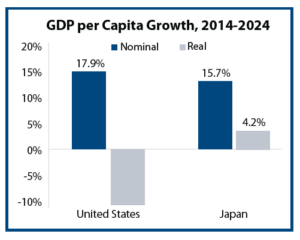
I even had ChatGPT create this little handy chart above to help visualize America’s lost decade. Maybe we should call our homeland “the sick old man of North America.”
Using real GDP per capita as a measure of the relative economic well-being of individuals in an economy gets us this result – since 2014, the Japanese have become 4.2% richer on average, while we Americans have become 10.02% poorer.
This reality will be ignored by our pundits and mass media because the pundits and press corps worship growth. When the GDP is higher, the economy is considered good. Growth good = population growth good, decline bad, end of story, or so we’re told. Except it isn’t the story here, is it? As I’ve shown above, soaring population growth and the soaring price inflation it inspired (because more demand = higher prices) resulted in Americans becoming 10% poorer over the past decade. In Japan, with its shrinking population, Japanese consumers became 4.2% wealthier on average. That’s the story.
Why do we worship growth, again?
Looking at skyrocketing housing costs alone, we can be confident that Americans lost ground financially during the past decade. Meanwhile, massive economic inequality in America further tells us that most Americans probably experienced a greater than 10% dip in per-capita wealth since 2014.
Consider Japan again. How could a country where the population shrank in size by 2.6% over ten years have economically outperformed one that expanded in population size by 6.5% during that same period? Because growth isn’t everything, and economic expansion driven by population growth alone is even less – it doesn’t represent real improvement or betterment in any meaningful way. It certainly doesn’t automatically translate into greater prosperity, as America’s shrinking middle class could attest. That’s why it’s possible to compare these two nations in per-capita GDP terms and discover that in reality, slow-declining Japan has been outpacing fast-expanding America for at least ten years now. The tortoise is indeed beating the hare.
But still, Japan’s economic performance should impress you only if you deeply care about GDP. America’s most myopic economists certainly do. You and I shouldn’t, however. Growth-driven prosperity, as measured by an ever-expanding GDP figure, is all too often an illusion. It’s definitely been illusory for the US, where I believe economic leaders have been advocating for aggressive population expansion for years in a desperate bid to keep that GDP figure going higher and higher indefinitely.
GROWTH ISN’T ALL IT’S CRACKED UP TO BE
In 2019, the late University of Maryland ecological economist Herman Daly published an article in Real World Economics Review that challenged the conventional thinking on growth. He called it “growthism” and said it defines well what ails the US economy in this modern era:
“Growthism itself has turned out to be a false god because growth in our finite and entropic world now increases ecological and social costs faster than production benefits, making us poorer, not richer (except for the top few percent),” Daly wrote. “Recognition of this reversal is obscured by the fact that our national accounts (GDP) do not subtract the costs of growth, but effectively add them by counting the expenditures incurred to defend ourselves from the un-subtracted costs of growth.”6
In other words, Daly is arguing that America’s relentless pursuit of growth at all costs is leaving its citizens worse off, not better. The costs of growth are seemingly increasing faster than the growth itself, and our leaders don’t understand why or what’s happening because the social and environmental costs borne by the population are re-added to the GDP figures, leading our economists and money managers to interpret them as net gains rather than the net losses they are.
The United States isn’t the only place where policymakers are pursuing relentless growth at the expense of their citizens’ quality of life.
Switzerland is a small, lovely, landlocked country famous for the Alps, the sophisticated particle accelerator at CERN in Geneva, and the fact that it has stayed unified for hundreds of years despite the population being divided among four distinct linguistic groups. I’ve been to Switzerland and I have family who live there. I remember seeing a well-kept, prosperous country with a generally content population more or less satisfied that material needs were being met and that the government was responsive to concerns. Switzerland regularly ranks near the top of various measures of development, safety, and security. It’s famous for skiing and wealthy elites gathering in the resort city of Davos every year. Switzerland isn’t generally known for social tensions, protests, ethnic strife, or what have you. But is that about to change?
Switzerland has been experiencing rapid population growth, and the people living there are growing tired of it.
Switzerland’s population has risen by 9% since 2014, according to that country’s Federal Statistical Office.7 That’s a galloping pace of growth even by American standards. The population there has ballooned by 43% since the 1970s.
My aunt moved to an area outside Zurich years ago with her Swiss husband to raise their family there. She’s spent most of her adult life in Switzerland and has pretty much seen it all. I asked her what such an aggressive pace of population growth has done to her adopted home. Not surprisingly, she isn’t too pleased. She said the growth has degraded the quality of life there. She pointed mainly to worsening congestion – packed freeways, commuter stress, and standing room only on trains. Social tensions are rising, too; considering the tiny size of the country, she said there’s a growing movement among Swiss politicians calling for capping the nation’s population, which suggests restrictions on immigration as that’s been the main driver of population growth, a movement that’s gaining popular support.
Then there’s Japan, where rapid population increase isn’t a problem at all.
Speaking from experience, I can confirm that population decline in Japan definitely has its downsides. Rural schools have closed. As young people flock to the cities, the old are left to the hamlets, and their remaining demographic makeups do not bode well for these villages’ futures. Businesses are forced to close due to a lack of customers. With fewer businesses comes fewer jobs, further fueling the exodus to the major metro centers, especially Tokyo. Empty buildings litter the Japanese countryside. But let’s be honest, this has been the story of rural America for decades now. It’s been the story in Japan for most of its “miracle” decades, too, when it developed itself into the world’s second-largest economy. US cities have been the beneficiaries of rural depopulation for some time now, as have Japanese cities, yet our media focuses on the plight of rural communities in Japan when covering its decline relative to the US.
The story of Japan’s decline has become so entrenched in our media that it is probably pointless for me to explain to American journalists how the data shows Japan’s economy has been outperforming America’s for the past decade on a per-capita basis. It goes against the narrative. It especially goes against the dogmatic notion that growth and only growth is good and that population decline is only ever measured as a net negative, never as an improvement. US journalists are accustomed to reporting that growth is good and any decline is bad, so they likely can’t comprehend how a country with a declining population could be seeing improvements in the economic conditions of average people, while the opposite holds true in the growing nation.
If American reporters can miss the fact that real GDP per capita has contracted by 10% in the US while it expanded by 4% in Japan over the past ten years, then perhaps they can be forgiven for missing other pertinent facts that I and anyone else can help describe, having lived there and researched some of the country. Wages are too low in Japan, but they are now rising, with Japanese workers experiencing some of the largest wage increases ever recorded in recent years. It’s becoming easier for college graduates to land jobs and even solid careers straight out of college – Japanese government statistics bear this out, as did some of my own students when I was teaching there. Today, those lucky enough to escape the congestion of the Tokyo metro region will find housing to be affordable, especially in the smaller-tier cities like the one where my wife and I purchased our home. And even the Tokyo suburbs are easy to afford, especially when compared to the bedroom communities surrounding New York, Boston, Philadelphia, Chicago, Los Angeles, and San Francisco. I rented a 3-bedroom, two-bathroom, two-story flat about a 50-minute train ride to central Shinjuku for less than $800 per month. That won’t even get you a studio apartment in New Jersey within a 2-hour drive to Manhattan.
The environment also seems nicer to me in Japan, at least in certain parts. Not that America isn’t blessed with an abundance of beautiful nature, but it’s much easier to escape the crowds and soak up the sights and smells of a forest or lakefront in much of Japan – not everywhere, of course, as Japan is still a famously crowded nation, physically smaller than California but home to 123 million, more than three times the population of California. My wife and I certainly suffered our share of overcrowded parks and congested freeways while living in the country.
There isn’t much of an affordability crisis in Japan, either, though data shows increased concern over higher food and fuel bills. Gas has always been expensive in the country; groceries as well, and these costs are legitimate concerns for older Japanese living on fixed incomes. But Japan hasn’t experienced anything like the price inflation America has. And even though foreigners have been blamed for spiking condominium costs in metro Tokyo, housing costs in Japan aren’t the crushing burden that they are here in America. This is perhaps measured best by the fact that, even accounting for population differences, Japan has a lot fewer homeless people by orders of magnitude. The Organization for Economic Cooperation and Development (OECD) counts a little over 3,000 homeless individuals living in Japan.8 In the United States, that number was more than 770,000 as of January 2024, according to data by the Department of Housing and Urban Development.9 While many factors contribute to these numbers, the cost of housing is certainly a huge component of this problem.
It’s no accident that GDP statistics are blind to these facts, and I believe Americans are starting to catch on. They are tiring of everything being so expensive and of life being so difficult. They are sick of seeing their natural heritage sold for short-term profits for folks who are already very wealthy. They’re tiring of the overcrowding and all the stress, crime, pollution, homelessness, depression, despair, and human misery that population growth and density create and magnify. They’re tired of everything that population growth is delivering as the costs began to outstrip the benefits quite some time ago. As Daly wrote back in 2019:
“Inevitably, national growth economies reach a point where many citizens begin to suspect that growth is no longer worth the cost of excessively rapid adaptation to an accelerating economy of no return – that so-called economic growth has in reality become uneconomic growth. John Stuart Mill recognized that long ago. Why have not more recognized it? Why is growth still the summum bonum of economists and politicians? Probably because growth is our substitute for sharing as a cure for poverty. And because our national accounts (GDP) are incapable of even registering uneconomic growth because they count only value added by labor and capital, and omit entirely the cost of using up that to which value is added, namely the entropic flow of natural resources, the very sap of life and wealth.”10
Growth, especially population growth, isn’t fueling prosperity. It’s resulting in the opposite: greater economic, social, and environmental harm. Meanwhile, the so-called experts are blind to this reality because they only look at the rising GDP number, and that number is rising in part due to the worsening conditions.
HUMAN DEVELOPMENT, ON THE SLOW SIDE
Don’t get me wrong, Japan does have its downsides. However, it’s a lovely place to visit as the millions of tourists flocking to Japan these days will tell you. It’s also a rather pleasant place to live. I’m looking forward to returning, hopefully sooner than later.
It’s remarkable how some of the nicest countries to live in are the ones that are growing the least. They’re clocking in sluggish GDP growth rates, but rank high on nearly any indicator for human well-being that you can imagine.
The United Nations Development Program (UNDP) invented and tracks the Human Development Index (HDI). It is an imperfect metric, measuring life expectancy, years of schooling, and gross national income per capita. I could think of several other indicators that I feel should be incorporated into the HDI metric. As imperfect as it is, it’s the first serious attempt at measuring true human welfare in a way that doesn’t factor in GDP growth. Given the statistics it does track, it should come as no surprise that there is very little correlation between HDI and GDP growth. If anything, these two alternate ways of measuring quality of life are inversely correlated.
UNDP measures HDI against a perfect score of 1. No nation scores this – alas, Heaven is not a place on Earth. Some countries come very close to a perfect score, however. At the top of the list, you will find Norway at 0.97. Norwegians are wealthy, they live long, and they’re very well educated. Average annual GDP growth there from 2014 to 2024 was just 1.75% according to World Bank data. That’s a paltry figure for an oil-rich country, but HDI tells us what is popularly known of Norway way better than GDP growth does. Norway is definitely on my bucket list of places to visit – beautiful scenery, beautiful people, fun towns and cities, I’m not too excited about trying the food, but that might turn out to be great, as well.
Germany ranks high with an HDI of 0.959. Its average annual GDP expansion from 2014 to 2024, according to the World Bank, was just 1.2% (1% by another source). Germany was known for anemic population growth despite its welcoming attitude toward immigrants. It experienced a surge in population during the Syrian refugee crisis, but that came with a host of social problems and a backlash against the former German premier and her open-doors policy, much like we saw in the United States in the run-up to Donald Trump’s return to the White House.
The top HDI rankings read like a rogues’ gallery of slow or no-growth economies: Norway, Germany, Sweden, Denmark, the Netherlands, and Belgium all make it to the top 10. These are all lovely countries, famously stable, boasting good public safety, high incomes, and offering their citizens a high quality of life. Finland and Singapore are included in the top 15 spots. Aggressively expanding Canada and the United States? 16th and 17th, respectively.11 I strongly suspect that the US ranks as high as it does thanks to a relatively high gross national income (GNI) figure; it greatly offsets America’s lower life expectancy compared to peer nations. Considering the massive income inequality in the US and a homeless population double the size of Iceland’s entire national population, I would advise UNDP to reconsider using this metric, or at the very least factor in the Gini coefficient, the most oft-cited statistical measure of inequality in a population’s income or wealth distribution.
HDI doesn’t measure crime, homelessness rates, suicide rates, rates of chronic illness, or sickness from environmental pollution. It doesn’t measure access to affordable, reliable public transportation. It doesn’t measure housing affordability, inflation rates, or the cost of living when measured against the median income. It misses how easy it is to get a table at a restaurant on a Friday evening. It doesn’t factor in whether or not advance reservations are required to enjoy a national park, or even a state or provincial park. It doesn’t measure the ease of locating stable, well-paying employment. For some of these metrics, we must look elsewhere.
The Economist Intelligence Unit, a business arm of The Economist media group, produces an annual Global Liveability Index (GLI). It’s designed as a means of telling international jet-setting elites where the best cities to live are. It is another imperfect method of measurement, for sure, as the GLI aims to reflect major urban centers’ living conditions rather than the liveability of nations in general. Still, a review of The Economist’s “most liveable cities” list tells a lot about the myth of growth-driven prosperity. To some degree, the faster your economy is expanding, the less likely your urban centers are to appear in The Economist’s “most liveable” list.
Last year, Vienna took the magazine’s top spot for the world’s most liveable city. World Bank data shows Austria’s annual GDP growth has been averaging just 1.2%. Vienna has since been bumped down to number two by Copenhagen, the new number one contender for 2025. Denmark has been averaging about 2.1% annual GDP growth for ten years, per the World Bank. Among other measures, this liveability index weighs the quality of healthcare, infrastructure, and education, alongside cultural factors, quality of entertainment, and other lifestyle factors. No American city is in the top ten, perhaps because of the weight given to infrastructure, healthcare, and crime.12
Aggressive population growth may lead to big, easy gains in GDP growth. It does nothing to improve human well-being and tells us nothing about the quality of life in any given place. Incidentally, fast-growing Switzerland boasts a very high HDI, and both Zurich and Geneva made The Economist’s top ten most liveable cities list. I hope they can hold on to these standings, because I have family living in Switzerland and I want them to enjoy comfortable lives.
BEYOND GDP
The tables may finally be turning on GDP.
A few weeks back, a team of contrarian economists gathered online to brainstorm ways to move “beyond GDP” toward better ways of measuring human wellbeing. Hundreds gathered to listen in and share their ideas.
Livia Bizikova of the International Institute for Sustainable Development said that she and other like-minded scholars and professionals who no longer have any confidence in GDP figures are “working on setting a limited number of indicators that countries can use” to more accurately understand conditions within their borders. During the webinar, she and others pointed to famous recent episodes – the pandemic, the 2008 financial crisis, among others – as reasons to no longer trust the old accounting ways, since the “information” GDP figures supposedly illuminated didn’t serve to help the world absorb the shocks of these crises at all.
Bizikova indicated that many government officials are starting to come around to the idea of ditching GDP. Like the citizens they’re supposed to be serving, they’re growing skeptical of it, if not weary or outright hostile to the long-standing supremacy of GDP over other considerations. “They are kind of ready now,” she said.
Let’s hope so.
It may take longer to convince America’s economic managers to fall out of love with GDP, but let’s hope we get there. If we can show them that growth-fueled prosperity is a myth, perhaps we can next convince them to accept the fact that population decline is desirable, inevitable over the long run (forced upon us unless we can get ahead of the change, encouraging and managing decline voluntarily), and a potentially powerful driver for improving human welfare and wellbeing. Perhaps we can convince them that negative population growth will translate to real net improvements to our quality of life over the long run.
For footnotes please refer to the PDF of the Forum paper by clicking here.








Nathanial Gronewold is the author of Anthill Economics: Animal Ecosystems and the Human Economy
and A Tale of Two Cranes: Lessons Learned from Fifty Years of the Endangered Species Act. He holds a
Ph.D. in environmental science from Hokkaido University and teaches journalism and media operations as
a faculty member at the University of Hawaii at Manoa.