
Common Sense Immigration Policy in an Era of Theatrics
- Nathanial Gronewold
- October 9, 2025
- Forum Papers
- Forum Paper
- 0 Comments
Click here for a downloadable, printable PDF version.
Biden’s immigration system was a mess; Trump’s is no better, and neither path will bring us closer to a saner policy approach.
An NPG Forum Paper
by Nathanial Gronewold, Ph. D.
October 2025
Abstract
It’s a gross understatement to say that the topic of immigration to the United States is contentious and controversial. It’s arguably the issue that most divides us, especially today. America has swung from a record surge in migrants and an overwhelmingly welcoming attitude toward immigration by the federal government to a collapse in new arrivals and a new federal administration visibly hostile to nearly all forms of immigration. Many see the current White House policy and approach toward immigration as overly heavy-handed, disorganized, ill-thought-out, and cruel in certain politicized cases, though many Americans may support some of the Trump Administration’s policies. Still, Donald Trump’s approach to immigration is best described as haphazard. That word can be equally applied to Joe Biden and his past approach. Biden’s policies led the public to view the southern border as chaotic and uncontrolled, smoothing the way for Trump’s reelection victory and return to the White House.
The media has muddied the waters quite a bit. Let me try to bring in some clarity. I’ll use hard facts to show why Biden’s immigration policies were failures and why Trump’s policies are also on track to fail, despite the uproars over ICE raids. If we can understand the reality of what we’re facing, then perhaps we can then explore ways to bring sanity to immigration in the US while also facilitating a gradual decline in the population of America, which is what our country truly needs.
THE TOUCHIEST SUBJECT
A few years ago, NPG kindly published a Forum paper I authored, the title of which asked a question: Will 2022 be the first year of US negative population growth?
It wasn’t – the population of the United States continued expanding that year largely due to a huge influx of migrants that few predicted. But at risk of sounding like a broken record, I’d like to pose the question again: Will 2025 be the first year of US negative population growth?
Personally, I doubt it, but apparently some researchers at the American Enterprise Institute (AEI) and a few journalists think there’s a chance the country’s population could fall this year. The AEI report hosting this prediction was published in July, but for some reason, news outlets only began picking it up in early September.
The reason the population could dip, even if by a practically insignificant amount, is attributed to President Trump’s decision to crack down on illegal immigration and to put new restrictions on legal permanent entry to the United States.
In a July 2025 Economic Perspectives report, AEI says the net inflow of migrants to US shores could actually turn negative this year by as much as -525,000. The authors forecast that in a low-immigration scenario, America’s “Cumulative Civilian Noninstitutionalized Population Increase” will turn negative, as well, and continue trending in negative territory out to 2028. Of course, they predict a terrible fate for the US economy. “Given drastic reductions in inflows and somewhat elevated outflows, we project that net migration is likely to be zero or negative in 2025,” the three authors wrote. “We find that the large drop in net migration in 2025 compared with 2024 will result in significantly slower labor force growth, slower employment growth, and a decrease in GDP growth of around 0.3–0.4 percentage points.”1
Some reporters picked up on this and concluded that negative net immigration, coupled with low birth rates, will send America’s population falling slightly this year. As journalist Derek Thomspon noted in his Substack, “Any decline in net immigration in excess of half a million could push the US into population decline.”2 Many would welcome this development, though it would be problematic for many industries. As a popular mainstream journalist, Thompson sees this as problematic.
The tone and tenor of reports and news articles like these cited above result from the popular assumption that the United States needs mass numbers of immigrants, legal or not, to thrive and even survive – but does it? Authors point to the horror of falling immigration because they insist the US population must continue to grow and grow – but must it?
In my view, the US and the world desperately needs a greatly reduced, and ultimately declining, rate of population growth; that this is inevitable; that plummeting birth rates are the clearest sign yet that the planet is overpopulated; and that population decline can be harnessed to enhance public welfare with the right policies. I also believe that America can have both net immigration and a declining population.
First, we need to come to terms with some pertinent facts about what’s been going on with immigration to the US in recent years. Understanding this will help us to better understand and appreciate what’s happening now on the ground amidst a crackdown that, like it or not, most Americans voted for.
The United States is a nation of immigrants. This point is indisputable, so let’s get that throat clearing out of the way.
Many may object to this characterization, and perhaps for good reason. I was born here, and chances are so were you. If I ever become an immigrant, it will be because I have moved to somewhere outside the United States. The US population is a bit over 15% foreign-born.3 That’s a high figure, among the highest in the world, but it still means that 85% of us are here because we were born here. You can’t call us immigrants.
But people who say “we are a nation of immigrants” mean something different. Subjectively, this statement is incorrect because the vast majority of the US population was born in the US. Objectively, the concept of the US as a nation of immigrants points to the reality that it was largely built by immigrants. This fact is indisputable.
After independence, the Founding Fathers deliberately pursued a policy of mass, open-ended immigration in a bid to rapidly expand and develop the country economically and militarily. Millions of people poured in, mostly from Europe, and their children became the first wave of successive generations that would fuel rapid population expansion for decades. Millions more were forced to come here, dragged to US shores in chains, and forced to work to build the country. They were victims of a shameful, evil system before they ultimately fought for and won their freedom. Above and below the Mason-Dixon Line, policies of mass immigration, voluntary or otherwise, were pursued to make the US rich and powerful. In those past decades, there was no debate or concern about overpopulation or mass immigration. The vast open American West was “discovered” and huge swaths of undeveloped territory were made available to migrants seeking conditions better than what their home countries could provide at the time. Expanding was an option back then. It’s a bit more problematic today (consider the water woes facing cities like Phoenix and Las Vegas).
Flash forward to today, and the picture couldn’t be more different.
OPENING THE FLOODGATES (KIND OF)
It’s probably safe to say that among the countries of the world, the United States is home to the largest number of individuals who do not have the legal right to be here. The Pew Research Center estimates that there are approximately 14 million illegal immigrants in the US.4 The Center for Immigration Studies says the figure is closer to 12 million.5 The Migration Policy Institute (MPI) puts the number at over 13 million.6 So, let’s say there are currently 13 million illegal residents in the US. Percentage-wise, that’s only about 4% of the US population, but it’s still a huge number. The population of illegal immigrants in the US is greater than the population of Sweden or Belgium.
Because illegal immigration is so ubiquitous in the US, it’s been ignored by politicians of all stripes for a very long time, likely on purpose. This hasn’t sat well with the US public for a long time. I recall after Donald Trump defeated Hillary Clinton to win his first term, a TV commentator whose name escapes me chalked up his victory to public anger at both the Republican and Democratic Parties on the issue. “Democrats like the votes and Republicans like the cheap labor,” I recall him saying, though I’m likely paraphrasing. Of course, illegal immigrants cannot vote in US elections, but their native-born children can. For as long as I can remember, Republicans in Texas opposed a border wall and any major federal crackdowns on illegal immigration because, indeed, they enjoyed and benefited from the cheap labor.
The US is famously welcoming to legal immigrants, at least before the start of 2025. However, the record shows that the Biden Administration was ridiculously welcoming, pursuing pro-immigration policies above and beyond anything we’ve seen during prior presidencies. Biden’s position on newcomers helped secure Kamala Harris’ election defeat in November 2024.
The numbers fluctuate and vary year after year depending on what the federal government’s policy is at the time, but the US does allow a large number of people to enter legally with the intention of permanent residency every year. Annual legal permanent immigration to America was about 1.2 million every year before Trump returned to the White House, according to MPI.7 Former President Joe Biden accelerated legal migration to America to an astonishing degree. It’s absolutely true that immigration is what’s been driving US population growth for several years now, so AEI is correct to predict some big impact from Trump’s moves to reverse Biden’s record.
And Biden’s record on immigration is just that – one for the record books.
According to MPI, in addition to the approximately 1.2 million annual level of legal admissions, Biden granted Temporary Protected Status (TPS) to about 1.7 million additional immigrants. Biden issued a record number of executive orders smoothing the legal pathways for immigrants in a bid to upend steps that Trump implemented during his first term and the restrictions on entries put in place due to the COVID-19 pandemic and the public health emergency that it caused.
Biden brought legal migration to levels above and beyond where they were prior to COVID. MPI lays out Biden’s aggressive pro-immigration record, noting in a recent report that the US government was “estimated to have naturalized nearly 3.5 million people, the most in any presidential term; more than doubled the length of work authorizations; and recrafted interior enforcement priorities to target national security and public safety threats, and recent border crossers.”8
Most famously, Biden didn’t choose inaction when millions of people began rushing into the US from Mexico during the great migration upheaval – rather, he lubricated that flow and made it easier for people turning up at border crossings to claim asylum and walk in. The Migration Policy Institute estimates that some 5.8 million people were allowed in this way. By early 2024, Biden realized that this massive influx of people might cost his party the election that year, but he eventually dropped out of the race anyway. Had he stayed in the race, he still would have lost to Trump on this issue alone, I would argue. “Biden was hounded by a strong public perception that the border was uncontrolled,” MPI’s researchers recalled. “Even when the administration further narrowed access to asylum at the border in June, the measure was seen as too little, too late.”9
Do the math, and it’s possible that in the four years Biden held the White House, his administration granted legal status to approximately 12.3 million newcomers, i.e., more than 3 million per year. Compare that figure to the 1.2 million legal immigrant arrivals that Americans are more used to seeing each year. And we’re not even counting any additional illegal entries that may have slipped past the government’s glance. Biden even hit the record for the number of foreign students granted visas to attend college in the US – 1.1 million, or about 6% of the total US university student population, according to MPI.
Some readers might object here, pointing out that the 1.7 million people granted Temporary Protected Status would’ve been just that, temporary visitors, and many of the 5.8 million allowed in on asylum claims would also have been sent home at some point. I call nonsense on this type of thinking. I think it’s safe to say that Biden fully intended to let all, or nearly all, of these 7.5 million entrants stay for good.
Also, please note how I’m using the word “illegal” and not “undocumented,” which is the preferred descriptor of some when discussing this topic. This is deliberate on my part, even if some consider it rude. The phrase “undocumented immigrant” was invented by the media as an attempt to, in my opinion, present this type of entry as normal and legitimate. I apologize if my chosen phrase “illegal immigrant” is offensive to some reading this now. I in no way wish to offend anyone, but for us to have a calm, rational discussion of this matter, it’s important to choose rhetoric that makes a clear distinction between authorized and unauthorized immigration, legal and illegal. Discussing this as a matter of “legal” and “undocumented” migration is done to deceive readers and blur the lines between the two ways to enter and reside in the US, which are quite different.
Let’s put it this way: if I’m pulled over for speeding on the freeway and I don’t have a driver’s license, I can’t plead my case to the police officer conducting the traffic stop. I can’t say, “Officer, look, I’m not driving illegally, I’m simply an undocumented motorist.” There’s no such thing in the eyes of the law, and I would be under arrest. It’s the same with immigration law.
In September 2023, Biden granted TPS to 472,000 Venezuelan immigrants.10 During this time, some were arguing with straight faces that the entire population of Guatemala had a legitimate basis to claim asylum and come live in the US. I think it would be rather detrimental to Guatemala’s economy if it were to lose 100% of its taxpayers and consumers.
Biden’s aggressive pro-immigrant policies and the migrant surges they inspired drove cities and states to the breaking point. Cities already suffering from housing shortages and a skyrocketing cost of living were asked to settle hundreds of thousands of new arrivals in a matter of months. New York City famously planned huge cuts to spending on services for New Yorkers so it could afford the $12 billion cost of taking care of the huge number of asylum seekers let in by Biden.11 The federal government initially offered pretty much zero financial support for the cities and states forced to pay for Biden’s immigration policies. Eventually, some token funding was disbursed, but it wasn’t nearly enough. The Common Sense Institute estimated that Denver was forced to spend up to $340 million of its taxpayers’ money providing housing, education, and healthcare services to new arrivals from the massive border surge, with the city cutting funding from other programs to help it cope.12 Chicago, Los Angeles, Boston, Washington, D.C., and other cities across the country had to scramble and cut spending to direct resources toward taking care of these newcomers.
Biden repeatedly insisted that he was powerless to stop the surge of border crossers claiming asylum. He very much facilitated a lot of it. And the fact that Trump put a stop to it within days of his arrival in Washington for his second term showed how Biden wasn’t telling the truth.
“Haphazard” is perhaps the best way to describe immigration to the United States under the Biden Administration. It seems that Biden intended to modernize the immigration system with new technologies, but he facilitated far more entries, legal and perhaps illegal, than the cities and states could cope with. It wasn’t smart, especially for someone running for reelection.
BIDEN, THE GREAT DEPORTER?
While large numbers of migrants were let in, deportations actually jumped under Biden, too. The numbers bear this out, so Biden was aggressively pro-legal immigration and anti-illegal immigration at the same time, finding clever new ways to expand legal entry for millions while cracking down on illegal border crossings.
MPI reports that Biden deportations during his term were on track to line up with Trump’s first term in office, with about 1.1 million compared to 1.5 million in Trump’s first four years. It’s something of a paradox, but MPI explains this was a consequence of the Biden Administration’s decision to shift immigration enforcement away from the interior of the country and toward a more central focus on crime prevention at the southwestern border. Basically, Biden’s Border Patrol grabbed people sneaking in through the desert under cover of darkness while rolling out the red carpet for millions turning up at authorized entry points to seek asylum. See MPI’s chart below, which outlines a surge in Biden deportations.
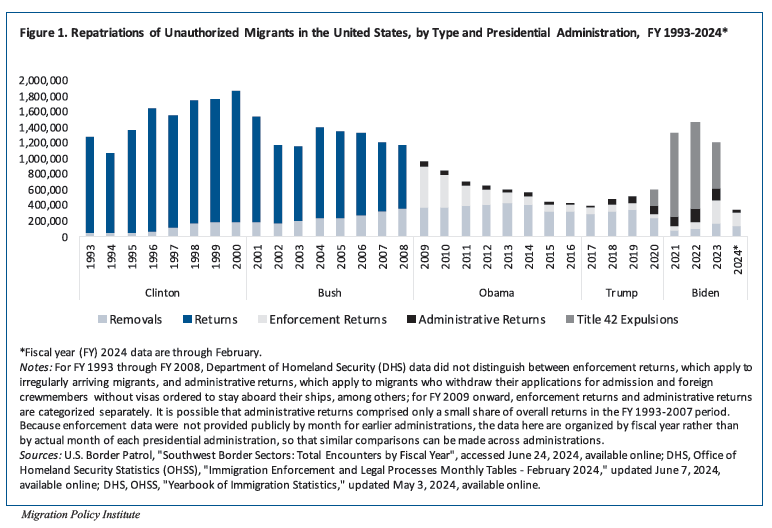
The surge in expulsions shown in dark gray represents Title 42 deportations, expulsions that the government authorized in response to the COVID-19 pandemic. But illegal immigration enforcement under Biden stayed strong after Title 42 expired, according to MPI. “In the 12 months after Title 42 ended, the Biden administration ramped up deportations under the standard U.S. immigration framework, Title 8, and removed or returned 775,000 unauthorized migrants – more than in any previous fiscal year since 2010,” the organization reported in its June 27, 2024 Policy Beat report.
Some disagree, arguing that Biden’s milquetoast effort to seem tough on illegal entry at the border was probably entirely ineffective. The Cato Institute thinks illegal immigration surged under his term, as well, with a possible net increase in the illegal immigrant population of up to 6 million.13
A strong majority of the legally authorized asylum claims were likely bogus, considering how people from over 140 countries were using Biden’s eased asylum processes to get in. There are only about 190 countries on the planet, and I know enough about this world to understand that 75% of it isn’t a hellscape that everyone must flee from. Three-quarters of the world isn’t on fire, either. I recall getting furious when reading someone arguing that these millions of migrants were forced to come to the US because of climate change. Such rhetoric does a massive disservice to the millions truly suffering from global warming’s ill effects. Besides, one could convincingly argue that the US is among the nations that are the most vulnerable to climate change – it would be out of the frying pan and into the fire.
Considering all this, the word “haphazard” is also probably the word that best applies to what Trump is doing now to try to reverse many or most of the Biden-era excesses. It’s a dragnet that’s sweeping up innocent tourists and hardened criminals alike. Meanwhile, what Trump is accomplishing in terms of actual deportations of illegal immigrants isn’t that far out of line with past presidents. In some cases, his predecessors achieved greater numbers of net expulsions. This is all important context to consider when viewing current media reporting on Trump’s immigration enforcement actions – we need to consider what they are and are not achieving.
SLAMMING THE DOOR SHUT, OR AT LEAST TRYING TO
Earlier this year, the people of Hawaii were forced to feel great shame and embarrassment over how a couple of hapless young tourists from Germany were treated by Honolulu’s airport immigration officers. We’re still humiliated by this episode, as it shows how truly idiotic the United States of Hysteria can be sometimes.
As the news told it, two German teenage girls were on an around-the-world backpacking adventure. They flew in from New Zealand to Honolulu, hoping to soak in the sights, sounds, and sunshine. They probably had Waikiki, Diamondhead, and other famous attractions on their itinerary. What they didn’t have was the address to every single hotel they planned to stay at while in the islands – because they were backpackers. I backpacked through China in my youth and had no idea where I would rest my head every night during my travels through that country. I had to figure out hotel and hostel arrangements on the fly. This is what backpacking is. The adventure of the uncertain wanderer forced to get by in a new and unfamiliar place every day is entirely the point of backpacking. But under Trump, US immigration officers armed with new tunnel vision have been rendered incapable of understanding this. They now have a quota to fill: show the boss more deportations. So, they took the lack of complete clarity on where these two harmless girls planned to sleep every single night for five weeks while in Hawaii as an excuse to detain them, toss them in jail next to real criminals for a night, and then force them on a flight to Japan the next day.14
How does harassing, strip-searching, detaining, and deporting two teenagers who planned to spend a lot of money on a five-week island-hopping adventure in Hawaii help keep America safe? It doesn’t. In fact, it does the exact opposite – because of colossal levels of stupidity like this, millions of foreigners with lots of money to spend are now avoiding the US. I don’t blame them. However, this is dinging America’s tourism revenues by billions of dollars, likely causing job losses, store closings, and greater economic and personal insecurity at tourist destinations across America. But try telling this to the people who thought it wise to harass and expel two German kids with money to spend from Hawaii.
There is now a seemingly endless line of reports on how tourists, long-term visa holders, foreign exchange students, and more are being treated like drug smugglers upon their attempted entries to the US, all so Trump can show us how he’s so much tougher than Biden when it comes to immigration. Well, point taken – immigration law enforcement has become much tougher now that he’s back in the White House. But now we get to read news stories on German tourists, Australian consultants, Canadian entertainers, and more being treated like garbage by our border agents. This is a clear indication that Trump’s crackdown is an unorganized, unplanned mess bereft of logic, which is why it could ultimately prove to be a failure.
MOOD SWING
It’s still early days, but here’s what we know about Trump’s record on immigration compared to his predecessor, and what he’s achieved so far in terms of his campaign promises of mass deportations and a secure border.
Trump is pursuing an expansion of U.S. Immigration and Customs Enforcement, or ICE. The plan is to use a larger ICE police force to capture, process, and deport illegal immigrants on a huge scale. The plan’s poor execution is giving the press a lot of material to fill the news cycle with almost every week, if not every day. ICE raids are now in the headlines, adorned with photographs of masked, heavily armed federal agents handcuffing and dragging suspects away. As of this writing, ICE reportedly raided an automobile factory in Georgia and arrested hundreds of South Koreans suspected of working there illegally.15 The administration promised to focus its ire on suspects with criminal records, but it’s clear that nearly anyone can get caught up in the crackdown.
Now, it’s fair to point out that all the Trump administration is trying to do is enforce the law. If those South Koreans arrested at the auto plant were found to have been living and working in the US illegally, then indeed, they should be sent home. I would be sent home too if I attempted to do the same thing in Seoul. But the heavy-handed approach that’s being applied across the board and indiscriminately to criminals and innocent fathers and mothers in equal measure is causing concern, criticism, and occasionally protests.
Trump entered office in mid-January. We’re only about eight months into his second term; that means hard statistics on what Trump’s crackdown is accomplishing are hard to come by. But we have some indications.
CNN reports that ICE has deported at least 200,000 people since January, while more than 60,000 may be in detention awaiting deportation.16 Trump reportedly wants to see at least 3,000 ICE arrests per day, but the agency has been averaging 1,000 to 2,000 per day.17 Trump has also cancelled Biden’s TPS for hundreds of thousands of Venezuelans and people of other nationalities. He’s moved to expedite removal procedures. And the lax Biden-era asylum rules and procedures are out the window. Whereas Biden was on track to admit a record number of asylum seekers, Trump appears on track to admit the fewest.
Among its more bizarre moves, the Trump Administration is facilitating the expulsion of illegal immigrants to third-party countries where these nationals have no citizenship or connections of any sort. Hurried and ill-thought-out measures like deporting people to other countries where they don’t belong are fodder for new embarrassing headlines and articles. Thus, the famous tale of the Guatemalan citizen who had legal US residency but was otherwise accidentally deported to a notorious extra-judicial prison in El Salvador. News reports say he has since been returned to the US, where he had legal residency and a work permit, but the administration is now trying to deport him to Uganda, of all places.
Many are no doubt “self-deporting” or choosing to leave the US rather than be swept up in the ICE raids. There’s probably no good way to count this figure, but the Center for Immigration Studies argues that around 1 million people have fled the US this way. The administration even offered cash incentives for people to self-deport.
A total of 200,000 deportations in eight months averages to 25,000 per month. At this rate, by the time Trump hits the milestone of one full year into his second term, he will have facilitated the expulsion of 300,000 verified or suspected illegal immigrants in one calendar year. If there are 13 million people residing illegally in the United States, then at this rate, it will take Trump-style immigration enforcement a little over 43 years to deport all of them. And this is assuming no others slip by the Border Patrol to join their ranks. A rate of 300,000 deportations per year is also lower compared to the more focused deportation policies of President Obama, who is estimated to have expelled some 375,000 from the United States on average each year during his eight years in office (assuming the estimate of Obama deporting 3 million people during his two terms is correct).
Should Trump succeed in deporting 300,000 illegal immigrants in one year, he will have dented this problem by a whopping 2.3% according to my math. At just 200,000 deportations by September, Trump has managed to expel just 1.5% of the people living in the US illegally. This is the reality that neither the White House nor our press corps want you to see.
Recall, if you will, MPI’s assertion that Biden deported 1.1 million people during his time in the White House. That comes to an average of 275,000 per year. If Trump succeeds in hitting 300,000 deportations in his first full year in office than he will only be achieving slightly more immigration enforcement than Joe Biden did, increasing federal deportations by just 25,000 per year. And Biden accomplished his numbers without the protests, bad press, and scary images of ICE raids that are designed mostly for show. Trump also got off to a slow start in his immigration crackdown. TRAC Immigration says that by March 2025, his figures were actually 10% below Biden’s, though Trump’s initiative has obviously built up some momentum since then.
This just goes to illustrate that despite the dramatic flair with which the Trump Administration is pursuing immigration enforcement, his orders are resulting in enforcement and deportation statistics that are pretty much in line with past presidencies, including Biden’s. The efforts are just focused in different directions. Biden legalized huge numbers of what would have been illegal entries through authorizing abuses to the asylum claim system while cracking down on illegal border crossings. Trump is targeting everyone with a focus on the interior of the country.
Let’s subtract the 1 million people CIS says left the country voluntarily, so 12 million illegal residents remain. It would still take Trump 40 years to deport them all at his current rate of annual expulsions. This problem has been a long time in the making. In terms of mass deportation, Trump is enforcing the law, but haphazardly and inefficiently. It’s also mostly for show, largely ineffective, and in line with what both past Democrat and Republican presidents have done.
The more things change, the more they stay the same.
Is illegal immigration a problem? I would argue that yes, it is. I must fill out documents, file taxes, and fulfill other bureaucratic procedures so the federal government knows exactly where I am and what I’m up to. It’s more than reasonable to argue that the government should know something about everyone who is in the country, even if only their name and occupation. I understand fully well that most people residing in the country illegally are good, decent people who are here because conditions are worse in their home countries, and they are only here to work, earn some money, and take care of their families. There are also no doubt hardened criminals among them. Trump’s enforcement efforts are dealing blows to everyone, including US citizens now losing their jobs as foreign tourism craters.
While cracking down on some illegal immigrants and hapless tourists who don’t have all their paperwork in order when they arrive at airport customs stations, the administration is also implementing restrictions on legal immigration to the US, even temporary legal immigration. Student visas are being rescinded, often erroneously. Naturalization will continue, albeit more slowly compared to Biden’s time in office. And if the news headlines are scaring away tourists, then they are probably causing millions of foreigners who want to immigrate and live in the US permanently to think twice. Thus, the AEI predictions of a steep drop-off in immigration and reports of the potential for the US to experience a population dip this year.
If the US population does decline this year (I highly doubt it), this would be somewhat counter to Trump’s stated goal of boosting the nation’s birth rate to facilitate a population increase. More to the point, Trump’s policies toward legal and illegal immigration and even simple temporary entries for tourists are haphazard and inefficient. By targeting everyone and not prioritizing those with criminal records, Trump is on track to deport fewer people each year than Obama did. His policies are hurting tourist hotspots and universities. But he has undoubtedly been successful in dramatically slowing the rate of net in-migration to America through massively bad public relations, as the American Enterprise Institute argued in that report cited earlier.18
IMMIGRATION AND POPULATION DECLINE
If you’re reading this, you’re probably already aware that this paper is part of NPG’s Forum series, which is a collection of papers advocating in favor of population decline in the US. I argue that the world and America need to embrace policies that facilitate a gradual and sustained decline in the human population. I acknowledge the obvious downsides of population declines but strive to highlight the benefits that are often overlooked. I also stress in my writings the inevitability of population decline, globally and in the United States. Nothing grows forever. Infinite growth in a finite system is impossible. Someday, the population of the US will fall. I just don’t think that day is today, or that we’ll see this phenomenon occur this year, though I could be incorrect, and AEI and other observers may be on to something.
Policies that promote and encourage mass immigration facilitate the opposite of population decline, so I’m not a fan. But make no mistake, I’m not a fan of the current US government approach under Trump, either.19 It’s largely ineffective, counter-productive, and mainly for show. In some of the worst instances, it’s cruel and inhumane. Strip-searching teenage tourists at the airport benefits no one and ultimately inflicts great harm on a lot of Americans. That Guatemalan father may have engaged in illegal activity, but why focus on him alone or force him on a plane to El Salvador or even Uganda? Why politicize his case? How does that help America? All it invites is bad publicity, lawsuits, public protests, and foreign tourists choosing other destinations while bypassing Hawaii, Florida, Las Vegas, and other American tourist attractions.
Biden and Trump both represent extreme approaches toward immigration policy and immigration law enforcement. What might a saner immigration policy look like?
We can start by acknowledging that the US doesn’t have the capacity to deport 12 or 13 million illegal residents in the four years Trump will spend in office. It will take him at least 40 years, and he doesn’t have that long. Even at a more aggressive Obama-level rate of expulsions, it would take the government something like 34 years to remove everyone. But that doesn’t mean we need to grant all these individuals green cards or passports, either. Breaking the law shouldn’t be rewarded; that’s what happened when Republican President Ronald Reagan famously granted amnesty to approximately 3 million people residing in the US without permission. Reagan’s 1986 measure was sold as an effort to crack down on illegal immigration. It had the opposite effect – more surged in on hopes that another amnesty would be granted to them down the road (as numerous Democratic politicians and even some Republicans have already proposed doing).
New technologies and new spending can be used wisely to significantly reduce illegal border crossings. A good policy would be to crack down on employers who knowingly and willfully hire illegal immigrants. Some industries might be able to prove that they are utterly dependent on this labor, such as certain agricultural sectors. If this is the case (even though farmers in other countries get by just fine without relying on mass numbers of illegal laborers), then perhaps a new temporary worker visa system for agricultural workers could be arranged.
Close the floodgates and enforce the law, but in an intelligent and focused manner. Zero in on hard criminals like Obama did. The federal government could more aggressively police visa overstays (congressional reports find that about 42% of people not authorized to live in the United States entered legally but overstayed their period of admission).20 Perhaps the government can put in humane, non-cash incentives for illegal residents to return home. If caught and deported, they could face stiff fines and permanent bans on reentry, but if they voluntarily leave, they could still be made eligible to try to return via legal avenues at some later date.
The government could also look at legal immigration pathways that (hopefully) sharply reduce the number of annual entries while prioritizing welcoming new immigrants who would undoubtedly benefit the US economy and US society.
What is the right scale of legal annual immigration? Negative Population Growth has a ballpark figure that it prefers (200,000 annually). I personally don’t know the right answer, so I’ll decline to provide my own favored number. All I know is that, yes, America is a nation of immigrants, and this proud tradition should continue. We are also an overcrowded nation where the existing population is straining under the weight of high prices, a high cost of living, aging infrastructure, a housing shortage, depleting natural resources, climate change, and an exceedingly competitive and relatively skimpy job market that massively favors employers over employees. The US is also environmentally damaged from decades of drilling and mining, and changes at the Environmental Protection Agency (EPA) threaten to make these industries even dirtier.
Our environment is stressed. Our cities are congested. Our national parks are crowded and often unpleasant places to be. To top it all off, our birth rates are plummeting as newer generations conclude they can’t afford families or simply see the benefits of not having children. As I’ve written before, the falling birth rate is the clearest indicator yet that America is too crowded and that its population must begin to decline. We don’t need more people, we need fewer.
Will there be some pain in experiencing population decline? Of course. But all the problems we are now suffering due to overpopulation will be thrown into reverse.
Population decline is both inevitable and desirable; I can’t stress these points enough. Facilitate a gradual decline in population and eventually the economic power imbalance will shift more favorably toward workers and their families and away from corporations and oligarchs.
Immigration under Biden was haphazard, expensive, and harmful. Immigration under Trump is similarly haphazard and causing the US unnecessary harm, only in different ways. Where is the happy middle? I don’t know, but I do know what the goal should be: Controlled entry to the United States, a continuation of sensible and reasonable legal immigration pathways, and an immigration system that embraces and even facilitates the inevitability of population decline.
For footnotes please refer to the PDF of the Forum paper by clicking here.








Nathanial Gronewold is the author of Anthill Economics: Animal Ecosystems and the Human Economy
and A Tale of Two Cranes: Lessons Learned from Fifty Years of the Endangered Species Act. He holds a
Ph.D. in environmental science from Hokkaido University and teaches journalism and media operations as
a faculty member at the University of Hawaii at Manoa.